Wednesday, February 1, 2012

Facebook Files for its Public Offering

"A million dollars isn't cool, you know what's cool?  A billion dollars."
-- Attributed to Sean Parker in the 2010 movie, The Social Network.

Today Facebook filed for its public offering.  Its registration statement (SEC Form S-1) is here.
I'll let the corporate folks figure out the financial aspects of this thing.  But in 2011, Facebook had net income of $1 billion on revenue of $3.7 billion.  I did look at the document to see if there are any interesting disclosures about intellectual property or similar issues.  There were surprisingly few, and nothing of any real interest.  Mostly it's the same boilerplate you see in any technology SEC filing.

At the beginning, "Summary Risk Factors" merely says:
Our business is subject to complex and evolving U.S. and foreign laws and regulations regarding privacy, data protection, and other matters. Many of these laws and regulations are subject to change and uncertain interpretation, and could harm our business;
Next, there is a generic reference to "legislative proposals" that doesn't mention things like SOPA/PIPA explicitly:
Our business is subject to complex and evolving U.S. and foreign laws and regulations regarding privacy, data protection, and other matters. Many of these laws and regulations are subject to change and uncertain interpretation, and could result in claims, changes to our business practices, increased cost of operations, or declines in user growth or engagement, or otherwise harm our business.

We are subject to a variety of laws and regulations in the United States and abroad that involve matters central to our business, including user privacy, rights of publicity, data protection, content, intellectual property, distribution, electronic contracts and other communications, competition, protection of minors, consumer protection, taxation, and online payment services. Foreign data protection, privacy, and other laws and regulations are often more restrictive than those in the United States. These U.S. federal and state and foreign laws and regulations are constantly evolving and can be subject to significant change. In addition, the application and interpretation of these laws and regulations are often uncertain, particularly in the new and rapidly evolving industry in which we operate. For example, the interpretation of some laws and regulations that govern the use of names and likenesses in connection with advertising and marketing activities is unsettled and developments in this area could affect the manner in which we design our products, as well as our terms of use. A number of proposals are pending before federal, state, and foreign legislative and regulatory bodies that could significantly affect our business. For example, a revision to the 1995 European Union Data Protection Directive is currently being considered by European legislative bodies that may include more stringent operational requirements for data processors and significant penalties for non-compliance. Similarly, there have been a number of recent legislative proposals in the United States, at both the federal and state level, that would impose new obligations in areas such as privacy and liability for copyright infringement by third parties. These existing and proposed laws and regulations can be costly to comply with and can delay or impede the development of new products, result in negative publicity, increase our operating costs, require significant management time and attention, and subject us to claims or other remedies, including fines or demands that we modify or cease existing business practices.
Then there is a generic discussion of IP litigation that also doesn't mention anything in particular.
We are currently, and expect to be in the future, party to patent lawsuits and other intellectual property rights claims that are expensive and time consuming, and, if resolved adversely, could have a significant impact on our business, financial condition, or results of operations.

Companies in the Internet, technology, and media industries own large numbers of patents, copyrights, trademarks, and trade secrets, and frequently enter into litigation based on allegations of infringement, misappropriation, or other violations of intellectual property or other rights. In addition, various “non-practicing entities” that own patents and other intellectual property rights often attempt to aggressively assert their rights in order to extract value from technology companies. We presently are involved in many such lawsuits, and as we face increasing competition and gain an increasingly high profile, including in connection with our initial public offering, we expect the number of patent and other intellectual property claims against us to grow. In addition, from time to time we may introduce new products, including in areas where we currently do not compete, which could increase our exposure to patent and other intellectual property claims from competitors and non-practicing entities.

Although the results of litigation and claims cannot be predicted with certainty, we do not believe that the final outcome of intellectual property claims that we currently face will have a material adverse effect on our business, financial condition, or results of operations. However, defending patent and other intellectual property claims is costly and can impose a significant burden on management and employees, we may receive unfavorable preliminary or interim rulings in the course of litigation, and there can be no assurances that favorable final outcomes will be obtained in all cases. We may decide to settle such lawsuits and disputes on terms that are unfavorable to us. Similarly, if any litigation to which we are a party is resolved adversely, we may be subject to an unfavorable judgment that may not be reversed upon appeal. The terms of such a settlement or judgment may require us to cease some or all of our operations or pay substantial amounts to the other party. In addition, we may have to seek a license to continue practices found to be in violation of a third party’s rights, which may not be available on reasonable terms, or at all, and may significantly increase our operating costs and expenses. As a result, we may also be required to develop alternative non-infringing technology or practices or discontinue the practices. The development of alternative non-infringing technology or practices could require significant effort and expense or may not be feasible. Our business, financial condition, or results of operations could be adversely affected as a result.
The "Legal Proceedings" disclosure only mentions one specific lawsuit, the Paul Ceglia suit.
Legal Proceedings

We are currently parties to multiple lawsuits related to our products, including patent infringement lawsuits brought by both other companies and non-practicing entities as well as class action lawsuits brought by users and advertisers, and we may in the future be subject to additional lawsuits and disputes.

We are also involved in other claims, lawsuits, government investigations, settlements, and proceedings arising from the ordinary course of our business.

Paul D. Ceglia filed suit against us and Mark Zuckerberg on or about June 30, 2010, in the Supreme Court of the State of New York for the County of Allegheny claiming substantial ownership of our company based on a purported contract between Mr. Ceglia and Mr. Zuckerberg allegedly entered into in April 2003. We removed the case to the U.S. District Court for the Western District of New York, where the case is now pending. In his first amended complaint, filed on April 11, 2011, Mr. Ceglia revised his claims to include an alleged partnership with Mr. Zuckerberg, he revised his claims for relief to seek a substantial share of Mr. Zuckerberg’s ownership in us, and he included quotations from supposed emails that he claims to have exchanged with Mr. Zuckerberg in 2003 and 2004. On June 2, 2011, we filed a motion for expedited discovery based on evidence we submitted to the court showing that the alleged contract and emails upon which Mr. Ceglia bases his complaint are fraudulent. On July 1, 2011, the court granted our motion and ordered Mr. Ceglia to produce, among other things, all hard copy and electronic versions of the purported contract and emails. On January 10, 2012, the court granted our request for sanctions against Mr. Ceglia for his delay in compliance with that order. We continue to believe that Mr. Ceglia is attempting to perpetrate a fraud on the court and we intend to continue to defend the case vigorously.

The Enforcement Division of the Securities and Exchange Commission (SEC) has been conducting an inquiry into secondary transactions involving the sale of private company securities as well as the number of our stockholders of record. In connection with this inquiry, we have received both formal and informal requests for information from the staff of the SEC and we have been fully cooperating with the staff. We have provided all information requested and there are no requests for documents or information that remain outstanding. We believe that we have been in compliance with the provisions of the federal securities laws relating to these matters.

Although the results of claims, lawsuits, government investigations, and proceedings in which we are involved cannot be predicted with certainty, we do not believe that the final outcome of the matters discussed above will have a material adverse effect on our business, financial condition, or results of operations. However, defending these claims is costly and can impose a significant burden on management and employees, we may receive unfavorable preliminary or interim rulings in the course of litigation, and there can be no assurances that favorable final outcomes will be obtained.
Note 7 to the financial statements concludes with this: "We are party to various legal proceedings and claims which arise in the ordinary course of business. In the opinion of management, as of December 31, 2011, there was not at least a reasonable possibility that we had incurred a material loss, or a material loss in excess of a recorded accrual, with respect to loss contingencies."  Your call as to what the second sentence means.

Monday, January 30, 2012

The Sky Is NOT Falling on the Content Industries

In 2011, Mark Lemley published an article entitled, "Is the Sky Falling on the Content Industries?"  The article pointed out how the legacy content industries historically tried to block new technologies and complained about how new technologies allegedly would destroy the content industries, and turned out to be wrong each time.

Techdirt and CCIA have now released a report, "The Sky Is Rising."  The report assembles data showing that the content industries are doing fine, despite their complaint about various aspects of the Internet.  At a minimum, there's plenty of profitable content, even if the legacy business models have had to work to get some of that profit.

Thursday, January 26, 2012

Friday, January 20, 2012

Patent Office Says That Using Prior Art in Patent Prosecution is Fair Use

People sometimes ask me about copying a journal article for prior art purposes, either to use in court or to give to the Patent Office in patent prosecution.  Can the owner of the copyright in the journal article complain about making those copies, or demand a royalty?  My response has always been that such copying is fair use.  As it turns out, the Patent Office agrees.

Thursday, January 19, 2012

Darrell Issa Formally Introduces the OPEN Act

Today Darrell Issa (R-Ca) and 24 co-sponsors formally introduced the OPEN Act, as H.R. 3782.  The OPEN Act is a rational alternative to SOPA and PIPA.  The bill is available in text and PDF form.
UPDATE:  The companion Senate bill is S. 2029, introduced by Ron Wyden (D-Ore.) and two co-sponsors.  This bill is also available in text and PDF form.

Wednesday, January 18, 2012

Ducks in a Patent Standing Order?

It has come to my attention that I am not the only patent person who likes ducks.  See page 4 of THIS.

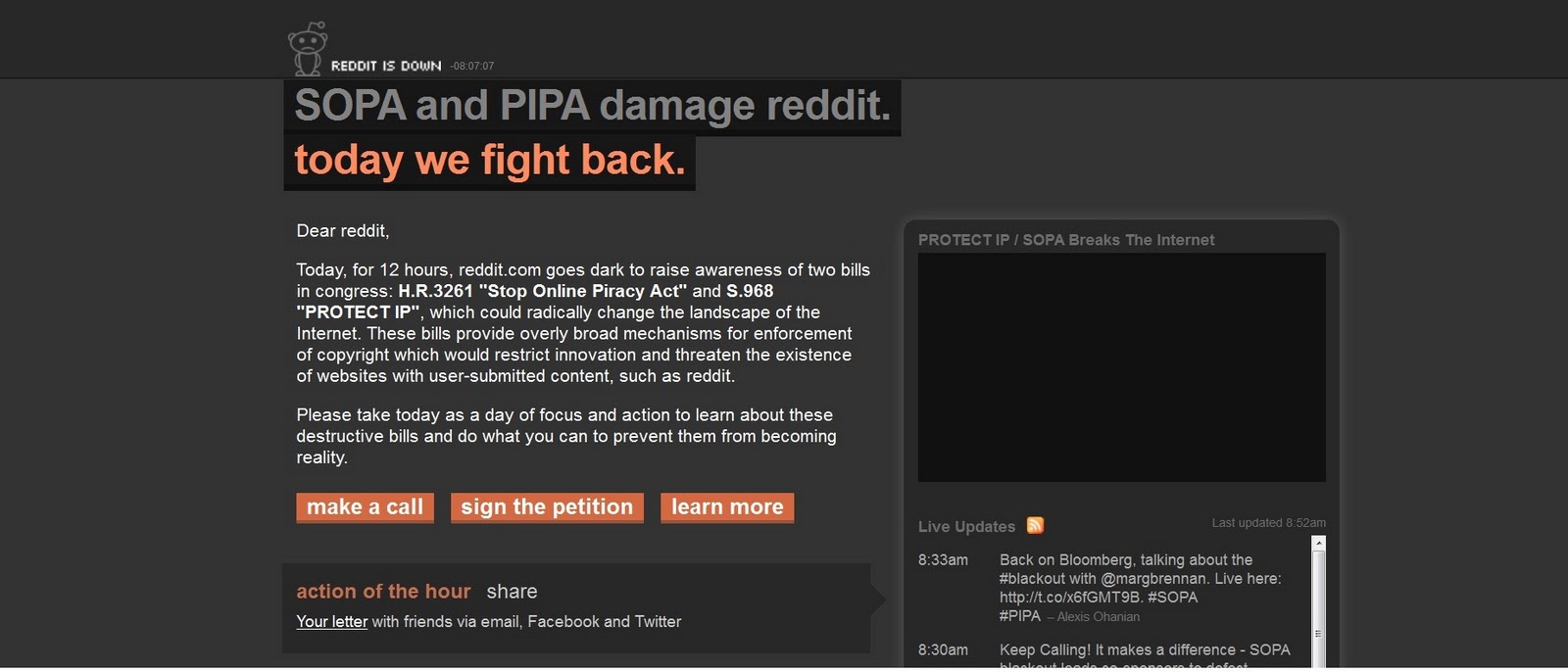
Today's Blackout/Protest Against SOPA/PIPA

As anyone who reads this blog already knows, today many web sites are protesting SOPA and PIPA, two bills that are a terrible idea.  Some web sites are active but are coordinating protests against the bills, such as EFF, Google, Techdirt, Public Knowledge, CDT, SOPA Strike, and SOPA ResourcesWired has a partially blacked out page, but you can navigate your mouse around the blackouts.  Some useful articles are by the Washington Post, by EFF and by Public Knowledge

I collected several of the blackout/protest screens.  Here are a few of them.

Google:
EFF:

Wikipedia:

Internet Archive:

Mozilla:

Reddit:

Craigslist:

Minecraft:

FARK (which amusingly has a "white" screen):

Zynga:

BoingBoing:

Imgur:

Wired:

TheOatmeal:

The RawStory:

CDT:

Alternet:

FailBlog:
Metafilter:

Moveon:

Greenpeace:

Wordpress:

XKCD:


Here's a link to Techdirt's gallery of blackout pages.


Supreme Court Reduces the Public Domain

Sadly, today the Supreme Court affirmed Golan v. Holder.  Golan had asked the Court to invalidate §514 of the Uruguay Round Agreements Act (URAA), which had granted Copyright protection to foreign works that previously were in the public domain.  The lower courts had rejected Golan's claim, and the Supreme Court agreed, by a 6-2 vote.
Here are writeups by SCOTUSblog, Patently-O and Techdirt.

Saturday, January 14, 2012

White House Opposes SOPA/PIPA

Today the White House issued a response to two petitions opposing SOPA and PIPA.  To the surprise of many, the administration opposed many of the provisions of these bills.  The full text of the response is as follows.
 __________________________________________________
Official White House Response to Stop the E-PARASITE Act. and 1 other petition

Combating Online Piracy while Protecting an Open and Innovative Internet

By Victoria Espinel, Aneesh Chopra, and Howard Schmidt

Thanks for taking the time to sign this petition. Both your words and actions illustrate the importance of maintaining an open and democratic Internet.

Right now, Congress is debating a few pieces of legislation concerning the very real issue of online piracy, including the Stop Online Piracy Act (SOPA), the PROTECT IP Act and the Online Protection and Digital ENforcement Act (OPEN). We want to take this opportunity to tell you what the Administration will support—and what we will not support. Any effective legislation should reflect a wide range of stakeholders, including everyone from content creators to the engineers that build and maintain the infrastructure of the Internet.

While we believe that online piracy by foreign websites is a serious problem that requires a serious legislative response, we will not support legislation that reduces freedom of expression, increases cybersecurity risk, or undermines the dynamic, innovative global Internet.

Any effort to combat online piracy must guard against the risk of online censorship of lawful activity and must not inhibit innovation by our dynamic businesses large and small. Across the globe, the openness of the Internet is increasingly central to innovation in business, government, and society and it must be protected. To minimize this risk, new legislation must be narrowly targeted only at sites beyond the reach of current U.S. law, cover activity clearly prohibited under existing U.S. laws, and be effectively tailored, with strong due process and focused on criminal activity. Any provision covering Internet intermediaries such as online advertising networks, payment processors, or search engines must be transparent and designed to prevent overly broad private rights of action that could encourage unjustified litigation that could discourage startup businesses and innovative firms from growing.

We must avoid creating new cybersecurity risks or disrupting the underlying architecture of the Internet. Proposed laws must not tamper with the technical architecture of the Internet through manipulation of the Domain Name System (DNS), a foundation of Internet security. Our analysis of the DNS filtering provisions in some proposed legislation suggests that they pose a real risk to cybersecurity and yet leave contraband goods and services accessible online. We must avoid legislation that drives users to dangerous, unreliable DNS servers and puts next-generation security policies, such as the deployment of DNSSEC, at risk.

Let us be clear—online piracy is a real problem that harms the American economy, and threatens jobs for significant numbers of middle class workers and hurts some of our nation's most creative and innovative companies and entrepreneurs.  It harms everyone from struggling artists to production crews, and from startup social media companies to large movie studios. While we are strongly committed to the vigorous enforcement of intellectual property rights, existing tools are not strong enough to root out the worst online pirates beyond our borders. That is why the Administration calls on all sides to work together to pass sound legislation this year that provides prosecutors and rights holders new legal tools to combat online piracy originating beyond U.S. borders while staying true to the principles outlined above in this response.  We should never let criminals hide behind a hollow embrace of legitimate American values.

This is not just a matter for legislation. We expect and encourage all private parties, including both content creators and Internet platform providers working together, to adopt voluntary measures and best practices to reduce online piracy.

So, rather than just look at how legislation can be stopped, ask yourself: Where do we go from here? Don’t limit your opinion to what’s the wrong thing to do, ask yourself what’s right. Already, many of members of Congress are asking for public input around the issue. We are paying close attention to those opportunities, as well as to public input to the Administration. The organizer of this petition and a random sample of the signers will be invited to a conference call to discuss this issue further with Administration officials and soon after that, we will host an online event to get more input and answer your questions. Details on that will follow in the coming days.

Washington needs to hear your best ideas about how to clamp down on rogue websites and other criminals who make money off the creative efforts of American artists and rights holders. We should all be committed to working with all interested constituencies to develop new legal tools to protect global intellectual property rights without jeopardizing the openness of the Internet. Our hope is that you will bring enthusiasm and know-how to this important challenge.

Moving forward, we will continue to work with Congress on a bipartisan basis on legislation that provides new tools needed in the global fight against piracy and counterfeiting, while vigorously defending an open Internet based on the values of free expression, privacy, security and innovation. Again, thank you for taking the time to participate in this important process. We hope you’ll continue to be part of it.

Victoria Espinel is Intellectual Property Enforcement Coordinator at Office of Management and Budget
Aneesh Chopra is the U.S. Chief Technology Officer and Assistant to the President and Associate Director for Technology at the Office of Science and Technology Policy
Howard Schmidt is Special Assistant to the President and Cybersecurity Coordinator for National Security Staff
__________________________________________________

Wednesday, January 11, 2012

SOPA/PIPA Update

A few new things about SOPA and PIPA, two bills that would destroy the Internet as we know it.  

Saturday, January 7, 2012

MAD Magazine Meets IKEA

Hopefully you will never have to assemble one of THESE.

Friday, December 23, 2011

"Hitler Reacts to SOPA"

Sooner or later, someone was bound to do a Hitler "Downfall" parody about SOPA.

Best humorous line: "Don't cry. Disney owns the rights to that emotion."

Best serious line:  "Piracy is a service problem.  The way to defeat piracy is to provide a better service than the pirates. . . . You don't get to destroy the Internet because it doesn't fit your business model!"

Tuesday, December 20, 2011

UMG v. Veoh Affirmed!

Today the Ninth Circuit affirmed UMG v. Veoh, holding that Veoh's user-generated content website is entitled to the "safe harbor" protection of 17 U.S.C. § 512.  This is great news for the Internet.  I'll update this later to provide an analysis of the opinion.

UPDATE:  I first wrote about this case back in May, when I reported on the oral argument in the case -- see that link for details.  Briefly, UMG v. Veoh is about UMG's claim that Veoh's user-generated content (UGC) web site contains copies of UMG's copyrighted music, and that Veoh should be secondarily liable when its users post allegedly infringing music on the Veoh site.  The trial court had granted summary judgment to Veoh on the grounds that it was immune from suit since it complied with the “safe harbor” notice-and-takedown procedures of the Digital Millennium Copyright Act, 17 U.S.C. § 512(c).  The case raises many of the same issues as the Viacom v. YouTube case presently pending in the Second Circuit Court of Appeals, where the trial court also granted summary judgment to YouTube's video service, which is similar in many respects to Veoh's service.

The Ninth Circuit affirmed Veoh's safe harbor under § 512 on all relevant issues:
  • "Storage at the direction of a user": "By its terms, § 512(c) presupposes that service providers will provide access to users’ stored material, and we would thus contravene the statute if we held that such access disqualified Veoh from the safe harbor."  On this issue, the Court cited EFF's amicus brief (which I co-authored): "As amici note, these access activities define web hosting — if the web host only stored information for a single user [as UMG argued], it would be more aptly described as an online back-up service."  The Court thus agreed that Veoh stored content at the direction of a user.  Storage "encompasses the access-facilitating processes that automatically occur when a user uploads a video."
  • The "knowledge" requirements: UMG argued that Veoh's general knowledge that there were music videos on its web site meant that Veoh had knowledge of alleged infringing activity.  The Court disagreed for several reasons.  First, "As an initial matter, contrary to UMG’s contentions, there are many music videos that could in fact legally appear on Veoh. . . . Copyright holders know precisely what materials they own, and are thus better able to efficiently identify infringing copies than service providers like Veoh, who cannot readily ascertain what material is copyrighted and what is not."  Thus, the Court held that "merely hosting a category of copyrightable content, such as music videos, with the general knowledge that one’s services could be used to share infringing material, is insufficient to meet the actual knowledge requirement under § 512(c)(1)(A)(i)."  Instead, the statute requires "specific knowledge of particular infringing activity."
  • No requirement to filter: The Court declined to require that a service provider like Veoh was obligated to implement filtering technologies. The Court rejected plaintiffs' argument that "Veoh should have taken the initiative to use search and indexing tools to locate and remove from its website any other content by the artists identified in the notices."
  • The financial benefit and control requirement: The Court held that "the 'right and ability to control' under § 512(c) requires control over specific infringing activity the provider knows about."
  • The Court rejected UMG's argument that proof of vicarious liability would automatically disqualify a service from the safe harbor.
This is a big victory for service providers, user-generated content sites, the viewing public, and the Internet generally.

Other posts discussing the case include those by EFF, Techdirt, the Hollywood Reporter, the Courthouse News Service, and Gigaom.

When Pigs Fly: EFF Files Amicus Brief Supporting . . . Viacom

Yesterday EFF filed my latest amicus brief, which supports . . . Viacom.  
EFF doesn't normally support Viacom, but in Brownmark v. Comedy Partners, we did.  Brownmark had sued Comedy Partners, Viacom, and other defendants for copyright infringement over Brownmark's music video.  An episode of South Park included a parody of Brownmark's video -- it's well established that such parodies are fair use.  The trial court granted Viacom's motion to dismiss the case on fair use grounds, and Brownmark appealed.  Brownmark claimed it was improper for a court ever to dismiss a case on fair use grounds without discovery and possibly a trial.  EFF supported the defendants on this legal issue.  
 
It's important for courts to be able to dispose of fair use cases quickly when the fair use is obvious (which it was in this case; see the videos here if you want to).  Requiring artists and others to go through a trial even when fair use is clear-cut will discourage them from fighting the claims and from innovating in the first place, as EFF's press release explains

Best of luck to Viacom and Comedy Partners on this particular appeal.

Sunday, December 18, 2011

Turn Off Your Computer and Go to Sleep

Read THIS when you're done with the Internet for the evening.

Thursday, December 8, 2011

Judge Newman Sure Likes Patents

Judge Newman of the U.S. Court of Appeals for the Federal Circuit has a reputation for being in favor of strong patent protection,  In case there was any doubt, read her dissenting opinion today in In Re Construction Equipment Co.  In the opinion, she basically says that the ex parte reexamination statute is unconstitutional if it can be used to invalidate a patent that already survived a validity challenge.  Fortunately, I don't think many people agree with Judge Newman on this.

It's Hard to Imagine, But SOPA/PROTECT-IP Will Be Worse Than This

In case you think that SOPA or PROTECT-IP will be bad without judicial supervision of takedowns, read this TechDirt article to see how bad things can be even with judicial supervision.  Here are the first two paragraphs of the article:

Imagine if the US government, with no notice or warning, raided a small but popular magazine's offices over a Thanksgiving weekend, seized the company's printing presses, and told the world that the magazine was a criminal enterprise with a giant banner on their building. Then imagine that it never arrested anyone, never let a trial happen, and filed everything about the case under seal, not even letting the magazine's lawyers talk to the judge presiding over the case. And it continued to deny any due process at all for over a year, before finally just handing everything back to the magazine and pretending nothing happened. I expect most people would be outraged. I expect that nearly all of you would say that's a classic case of prior restraint, a massive First Amendment violation, and exactly the kind of thing that does not, or should not, happen in the United States.

But, in a story that's been in the making for over a year, and which we're exposing to the public for the first time now, this is exactly the scenario that has played out over the past year -- with the only difference being that, rather than "a printing press" and a "magazine," the story involved "a domain" and a "blog."
 
This nightmare happened to a blog represented by my former partner Andrew Bridges.  So much for the First Amendment!

Sunday, December 4, 2011

Dave Barry's Holiday Gift Guide!

It's time for . . . Dave Barry's annual Holiday Gift Guide! This year the Guide is so good that I am actually tempted to buy one of these (the Wrap-a-Nap, of course).

Friday, December 2, 2011

Stephen Colbert Explains SOPA


In the first video, don't miss the Mickey Mouse doll with an anti-infringement slogan.  And the fact that the FBI admits that its estimate of the dollar amount lost to piracy has no factual support.  In the second video, don't miss Colbert's and Zittrain's debate about whether Justin Bieber should go to jail.  (They seem to agree that he should, but for different reasons.)

Federal Circuit Orders Venue Transfer Out of Delaware

In recent years, the Federal Circuit has been granting petitions for writs of mandamus and ordering venue transfers of cases filed in the Eastern District of Texas.  Today the CAFC granted such a petition in a case filed in Delaware, against a defendant incorporated in Delaware.  In Re Link_A_Media.  Delaware district courts had been routinely denying venue transfer motions where the defendant was incorporated in Delaware, largely on the theory that the defendant "is incorporated in Delaware and, thus, cannot claim surprise at being brought into the Delaware courts for litigation.”

Today the Federal Circuit ruled that venue transfer motions cannot be denied solely on the basis of the defendant's state of incoroporation, but that all the relevant factors under 28 U.S.C. § 1404(a) must be considered.  The case involved a Northern California-based defendant sued by a Bermuda-based holding company affiliated with a Northern California-based corporation (Marvell).  Thus, all the relevant witnesses on both sides were in Northern California.  The CAFC also commented that the U.S. District Court for the Northern District of California "is equally equipped to address" patent cases as is the District of Delaware (hooray for us).

The Court did not rule on what would have happened if the plaintiff had also been incorporated in Delaware -- that is perhaps the next case.

--Michael

Wednesday, November 30, 2011

In View of Events From the Last Several Days, Are PROTECT-IP and SOPA Even Necessary?

I've written in the past about the so-called PROTECT-IP act and SOPA, two proposed bills currently before Congress.  Proponents of the bills claim that they are necessary to protect legacy content industries against "rogue websites" that supposedly enable intellectual property theft.  As other opponents of the bills and I have noted, the bills are overbroad, overreaching, and will do more harm than good.

Events of the last several days suggest that the government and IP holders are not afraid to use (and perhaps abuse) existing case law and court procedures to deal with "rogue" websites.  In particular:

  • On Monday and again today, several sources reported about a Nevada district judge granting a far-reaching TRO sought by Chanel, the maker of luxury goods.  As a private party, Chanel asked the court to seize domain names that allegedly sold counterfeit goods.  The Court didn't simply grant an injunction against the defendants prohibiting them from using any Chanel marks or selling any Chanel products.  It went further and ordered (1) an injunction against the top-level domain name registry, directing it to change the registrar of record for the domain names to GoDaddy; (2) an injunction telling GoDaddy to change the DNS data for the domain names so the domain names resolve to a site where a copy of the case documents are hosted; and (3) an order requiring Google, Bing, Yahoo, Facebook, Google+, and Twitter to "de-index and/or remove [the domain names] from any search results pages."

It's not clear whether the ICE seizures actually comply with due process, or are otherwise illegal.  It's even more unclear whether the Nevada court's order is legal (among other things, it doesn't seem proper for a court to enjoin non-parties such as Google, Bing, etc.)  However, if the government already has the power to seize websites, and if existing law already gives private companies such as Chanel the right to obtain such broad remedies, it's hard to see what PROTECT-IP act and SOPA will really add to stopping "rogue websites."  Perhaps, as we have argued, what the proponents of those bills really want is to obtain far broader powers against legitimate Internet-based companies and free speech.

Tuesday, November 29, 2011

Internet "Piracy" Explained

When legacy content industry lobbyists say that file sharing is "theft" or "piracy," their facts are not quite right.  Here's a handy diagram explaining the situation.

Saturday, November 26, 2011

Judge Posner Puts a Picture of an Ostrich in an Opinion

Judge Posner of the Seventh Circuit put a picture of an ostrich -- and something worse -- in this opinion. Scroll down to pages 5-6.

Friday, November 18, 2011

Fenwick's Magnum Opus on Internet Copyright

Fenwick & West has prepared a 557-page paper entitled, "Advanced Copyright Issues on the Internet."  I obviously haven't read this entire paper, but at least parts of it seem to include a comprehensive discussion of Internet-related Copyright law.

Thursday, November 17, 2011

Miscellaneous Links About Yesterday's SOPA Hearings

Yesterday the House Judiciary Committee held a hearing on SOPA, the so-called "Stop Online Piracy Act."  The above site has a link to a webcast of the hearings.  Techdirt's summary of the hearings is here; as that summary notes, surprisingly some of the Representatives expressed concerns about the overreaching aspects of the proposed act.  (Techdirt has many other articles about SOPA and the hearings.)

Here are some other links about SOPA:

Wednesday, November 16, 2011

Planning Ahead for Thanksgiving?

 Here's some suggestions.  But note that several people advise avoiding "The ancient marshmallow yams of sorrow."

Wednesday, November 9, 2011

Post-Hearing Letter Briefs in Viacom v. YouTube

The Second Circuit heard oral argument in Viacom v. YouTube and Premier League v. YouTube on October 18, 2011.  Following the argument, on October 25, the Court asked the parties to submit letter briefs on the following two questions:

The parties are hereby ordered to submit letter briefs, not exceeding ten pages doublespaced, on the following questions: (1) whether and how the red-flag knowledge provision would apply under the Defendants’ “specific” knowledge construction of § 512(c)(1)(A); and (2) whether YouTube’s “syndication” of videos to third parties falls outside the scope of safe harbor protection for activities that occur “by reason of . . . storage at the direction of a user” under § 512(c)(1).
 
YouTube's November 1 letter brief is here; the plaintiffs' joint November 8 letter brief is here.  Needless to say, the parties didn't agree on very much.

Monday, November 7, 2011

SOPA: A Really Bad Idea

Some people have asked me about SOPA, or the "Stop Online Piracy Act."  SOPA is a House bill that is the House's version of PROTECT-IP, a Senate bill.  

If it passes, SOPA would be a disaster for technology companies. SOPA would allow the legacy content industries to use litigation to shut down any new technology they didn't like. A neutral analysis of the act is here.  Other people have written about some of the many problems with the bill.  EFF has several articles about the act, including this one, this one and this one. Techdirt has many articles about the act, including this comprehensive article, this article describing how the bill's supporters misstate what it would do, and this article discussing how SOPA would harm innovation.  Here's a Techcrunch article about the bill. 

There are several petitions opposing the act. I have signed two of them, one sponsored by the EFF and one on the whitehouse.gov website.


UPDATE: Here is Techdirt's even more comprehensive post about SOPA.


MP3Tunes Amended Opinion: DMCA Applies to pre-1972 Sound Recordings

In August I mentioned a ruling in the Capitol Records v. MP3Tunes case, in which a district court gave MP3Tunes broad DMCA protection for much (but not all) of its activity.  The record company plaintiffs moved for reconsideration, in part claiming that the DMCA does not give protection to songs recorded before 1972.  Such songs are presently protected by state law, not the federal Copyright act.  In response, the court issued an amended opinion holding that the DMCA applies to pre-1972 sound recordings

"The plain meaning ofthe DMCA's safe harbors, read in light oftheir purpose, covers both state and federal copyright claims. Thus, the DMCA applies to sound recordings fixed prior to February 15, 1972."

Thursday, November 3, 2011

Copyright Irony of the Day

So let's get this straight:  John Wiley publishes a book, "BitTorrent for Dummies," telling people how to use that software to share copyrighted files without permission.  Surprise!  BitTorrent users wind up sharing other books in Wiley's "Dummies" family.  What's Wiley to do?  Sue them, of course.

Wednesday, November 2, 2011

"The 32 Wittiest Comebacks Of All Time"

Snappy comebacks.  While Winston Churchill is probably mentioned most often, my favorite is Faulkner vs. Hemingway.

Saturday, October 29, 2011

This Blog Is in Trouble

. . . if THIS patent application ever issues.  "Business method protecting jokes."

Tuesday, October 25, 2011

"Priorities and Special Projects of the United States Copyright Office"

The Copyright Office has released a document entitled "Priorities and Special Projects of the United States Copyright Office."  This discusses the Office's goals for the next several years.

2011 PricewaterhouseCoopers Patent Litigation Study

The 2011 PricewaterhouseCoopers Patent Litigation Study is now available.  PWC often comes up with interesting observations, particularly regarding non-practicing entities (NPEs) and patent litigation.  See page 7 for the summary.

Friday, October 21, 2011

Oral Argument in Viacom v. YouTube

On Tuesday, October 18, 2011, the Second Circuit Court of Appeals heard oral argument in Viacom v. YouTube and Premier League v. YouTube.  Although no transcript is available, articles about the oral argument are here, here, here, here and here.  Mark Lemley's opinion piece on the lawsuit is here.

My favorite line from the reported articles is a comment by YouTube's lawyer, responding to the plaintiffs' arguments that YouTube should have done more to screen or filter for allegedly infringing works:
"We've done A, B, C and D and plaintiffs are saying, 'You should have done E and F,'" he said. "If we did E and F, they would say, 'You should have done G and H.'"
A decision is likely to take at least several months.

Friday, September 30, 2011

Chicken!

Chicken chicken chicken.  That is all.

2011 Ig Nobel Prize Winners!

The 2011 Ig Nobel Prize Winners have been announced!  (I would have posted this last night, but I was too busy reading the winner of the "literature" prize.)

Monday, September 19, 2011

Friday, September 16, 2011

President Obama Signs the ‘‘Leahy-Smith America Invents Act’’

Today President Obama signed the ‘‘Leahy-Smith America Invents Act,’’ also known as the patent reform act.  The final bill is here in PDF form and here in text form (with handy hyperlinks to its various sections).  The U.S. Patent and Trademark Office's web page on the bill is here, and additional government press releases are here, here and here.

While the bill unquestionably contains the most significant changes to the patent laws since the current version of the Patent Act was passed in 1952, the bill does not "reform" the patent laws as much as many people had hoped.  Patent reform bills have been before Congress for most of the last decade, and competing interest groups have blocked various reforms in earlier proposals.  For example, the electronics, computer and other tech industries would have liked to have seen reform of how patent damages are awarded, but pharmaceutical companies and non-practicing entities opposed such changes.  Today's bill is a compromise containing a number of unrelated changes, many of which are highly technical in nature and matter only to patent lawyers.

Since the Senate passed the House version of the bill, H.R. 1249, on September 8, there have been tons of articles written about the bill's scope and effect.  Rather than write my own analysis, I'll just link to a bunch of them.  (This post will therefore get updated regularly as I receive additional articles of interest.)

First Circuit Decision in Sony v. Tenenbaum

Today the First Circuit Court of Appeals released its decision in Sony BMG Music Entertainment v. Tenenbaum.  The PDF of the opinion is here and a text version is here.

As explained by EFF's post, the Court overturned a trial judge's decision to lower a damage award against a college student found liable for file sharing songs.  The trial judge had found the $675,000 damage award for 30 songs to be unconstitutional.  The appeals court held that the trial court should not have considered the constitutionality of the award before first reducing the award using a procedural device called a "remittur."  The case will go back to the trial judge for that purpose.

Thursday, September 15, 2011

Next Time, Play "Love Minus Zero, No Limit."

This guy should probably NOT have played "Just Like a Woman."

Best Taxidermy Commercial Ever?

If there is such a thing as the best Taxidermy commercial ever, THIS would be it.

Friday, September 9, 2011

Duck of the Day

This blog would be remiss if we did not mention this duck.

Thursday, September 8, 2011

Patent of the Day

With the passage of the Patent Reform Act, there will be lots of talk about creating jobs and so forth.  Doubtless a new patent this week, "Apparatus for facilitating the construction of a snow man/woman," U.S. Patent No. 8,011,991, will create many of those new jobs.  Update:  Techdirt likes this patent almost as much as I do.

Patent Reform Act Passes the Senate

Patently-O reports that the Senate has passed the House version of the Patent Reform Act, also known as the "Leahy-Smith America Invents Act."  President Obama is expected to sign the bill promptly.
 
A related article by that blog discusses three key aspects of the new act.
 
Darn, now I am going to have to read the thing.  At least I can keep in mind the very first comment on the Patently-O blog:
 
Dear Congress,
Thank you very much.
Yours truly,
China