Monday, January 30, 2012

The Sky Is NOT Falling on the Content Industries

In 2011, Mark Lemley published an article entitled, "Is the Sky Falling on the Content Industries?"  The article pointed out how the legacy content industries historically tried to block new technologies and complained about how new technologies allegedly would destroy the content industries, and turned out to be wrong each time.

Techdirt and CCIA have now released a report, "The Sky Is Rising."  The report assembles data showing that the content industries are doing fine, despite their complaint about various aspects of the Internet.  At a minimum, there's plenty of profitable content, even if the legacy business models have had to work to get some of that profit.

Thursday, January 26, 2012

Friday, January 20, 2012

Patent Office Says That Using Prior Art in Patent Prosecution is Fair Use

People sometimes ask me about copying a journal article for prior art purposes, either to use in court or to give to the Patent Office in patent prosecution.  Can the owner of the copyright in the journal article complain about making those copies, or demand a royalty?  My response has always been that such copying is fair use.  As it turns out, the Patent Office agrees.

Thursday, January 19, 2012

Darrell Issa Formally Introduces the OPEN Act

Today Darrell Issa (R-Ca) and 24 co-sponsors formally introduced the OPEN Act, as H.R. 3782.  The OPEN Act is a rational alternative to SOPA and PIPA.  The bill is available in text and PDF form.
UPDATE:  The companion Senate bill is S. 2029, introduced by Ron Wyden (D-Ore.) and two co-sponsors.  This bill is also available in text and PDF form.

Wednesday, January 18, 2012

Ducks in a Patent Standing Order?

It has come to my attention that I am not the only patent person who likes ducks.  See page 4 of THIS.

Today's Blackout/Protest Against SOPA/PIPA

As anyone who reads this blog already knows, today many web sites are protesting SOPA and PIPA, two bills that are a terrible idea.  Some web sites are active but are coordinating protests against the bills, such as EFF, Google, Techdirt, Public Knowledge, CDT, SOPA Strike, and SOPA ResourcesWired has a partially blacked out page, but you can navigate your mouse around the blackouts.  Some useful articles are by the Washington Post, by EFF and by Public Knowledge

I collected several of the blackout/protest screens.  Here are a few of them.

Google:
EFF:

Wikipedia:

Internet Archive:

Mozilla:

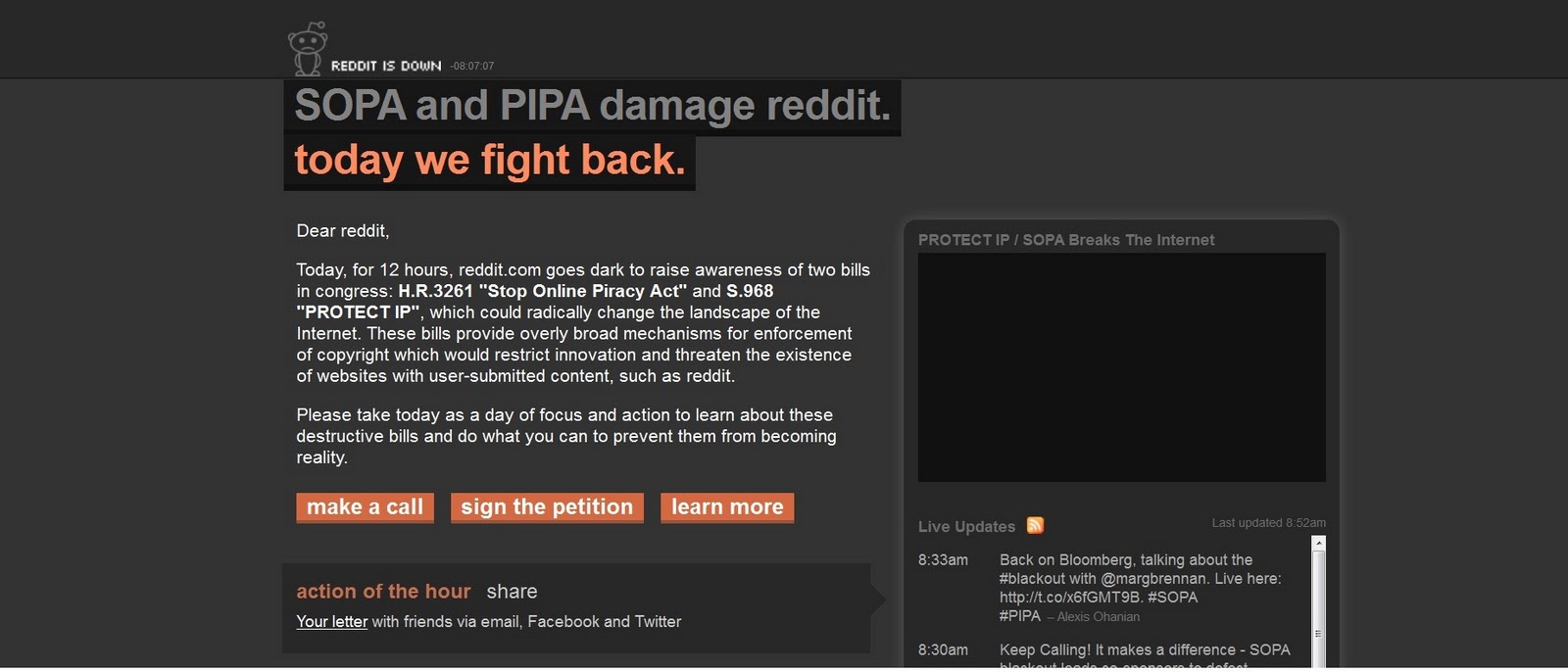
Reddit:

Craigslist:

Minecraft:

FARK (which amusingly has a "white" screen):

Zynga:

BoingBoing:

Imgur:

Wired:

TheOatmeal:

The RawStory:

CDT:

Alternet:

FailBlog:
Metafilter:

Moveon:

Greenpeace:

Wordpress:

XKCD:


Here's a link to Techdirt's gallery of blackout pages.


Supreme Court Reduces the Public Domain

Sadly, today the Supreme Court affirmed Golan v. Holder.  Golan had asked the Court to invalidate §514 of the Uruguay Round Agreements Act (URAA), which had granted Copyright protection to foreign works that previously were in the public domain.  The lower courts had rejected Golan's claim, and the Supreme Court agreed, by a 6-2 vote.
Here are writeups by SCOTUSblog, Patently-O and Techdirt.

Saturday, January 14, 2012

White House Opposes SOPA/PIPA

Today the White House issued a response to two petitions opposing SOPA and PIPA.  To the surprise of many, the administration opposed many of the provisions of these bills.  The full text of the response is as follows.
 __________________________________________________
Official White House Response to Stop the E-PARASITE Act. and 1 other petition

Combating Online Piracy while Protecting an Open and Innovative Internet

By Victoria Espinel, Aneesh Chopra, and Howard Schmidt

Thanks for taking the time to sign this petition. Both your words and actions illustrate the importance of maintaining an open and democratic Internet.

Right now, Congress is debating a few pieces of legislation concerning the very real issue of online piracy, including the Stop Online Piracy Act (SOPA), the PROTECT IP Act and the Online Protection and Digital ENforcement Act (OPEN). We want to take this opportunity to tell you what the Administration will support—and what we will not support. Any effective legislation should reflect a wide range of stakeholders, including everyone from content creators to the engineers that build and maintain the infrastructure of the Internet.

While we believe that online piracy by foreign websites is a serious problem that requires a serious legislative response, we will not support legislation that reduces freedom of expression, increases cybersecurity risk, or undermines the dynamic, innovative global Internet.

Any effort to combat online piracy must guard against the risk of online censorship of lawful activity and must not inhibit innovation by our dynamic businesses large and small. Across the globe, the openness of the Internet is increasingly central to innovation in business, government, and society and it must be protected. To minimize this risk, new legislation must be narrowly targeted only at sites beyond the reach of current U.S. law, cover activity clearly prohibited under existing U.S. laws, and be effectively tailored, with strong due process and focused on criminal activity. Any provision covering Internet intermediaries such as online advertising networks, payment processors, or search engines must be transparent and designed to prevent overly broad private rights of action that could encourage unjustified litigation that could discourage startup businesses and innovative firms from growing.

We must avoid creating new cybersecurity risks or disrupting the underlying architecture of the Internet. Proposed laws must not tamper with the technical architecture of the Internet through manipulation of the Domain Name System (DNS), a foundation of Internet security. Our analysis of the DNS filtering provisions in some proposed legislation suggests that they pose a real risk to cybersecurity and yet leave contraband goods and services accessible online. We must avoid legislation that drives users to dangerous, unreliable DNS servers and puts next-generation security policies, such as the deployment of DNSSEC, at risk.

Let us be clear—online piracy is a real problem that harms the American economy, and threatens jobs for significant numbers of middle class workers and hurts some of our nation's most creative and innovative companies and entrepreneurs.  It harms everyone from struggling artists to production crews, and from startup social media companies to large movie studios. While we are strongly committed to the vigorous enforcement of intellectual property rights, existing tools are not strong enough to root out the worst online pirates beyond our borders. That is why the Administration calls on all sides to work together to pass sound legislation this year that provides prosecutors and rights holders new legal tools to combat online piracy originating beyond U.S. borders while staying true to the principles outlined above in this response.  We should never let criminals hide behind a hollow embrace of legitimate American values.

This is not just a matter for legislation. We expect and encourage all private parties, including both content creators and Internet platform providers working together, to adopt voluntary measures and best practices to reduce online piracy.

So, rather than just look at how legislation can be stopped, ask yourself: Where do we go from here? Don’t limit your opinion to what’s the wrong thing to do, ask yourself what’s right. Already, many of members of Congress are asking for public input around the issue. We are paying close attention to those opportunities, as well as to public input to the Administration. The organizer of this petition and a random sample of the signers will be invited to a conference call to discuss this issue further with Administration officials and soon after that, we will host an online event to get more input and answer your questions. Details on that will follow in the coming days.

Washington needs to hear your best ideas about how to clamp down on rogue websites and other criminals who make money off the creative efforts of American artists and rights holders. We should all be committed to working with all interested constituencies to develop new legal tools to protect global intellectual property rights without jeopardizing the openness of the Internet. Our hope is that you will bring enthusiasm and know-how to this important challenge.

Moving forward, we will continue to work with Congress on a bipartisan basis on legislation that provides new tools needed in the global fight against piracy and counterfeiting, while vigorously defending an open Internet based on the values of free expression, privacy, security and innovation. Again, thank you for taking the time to participate in this important process. We hope you’ll continue to be part of it.

Victoria Espinel is Intellectual Property Enforcement Coordinator at Office of Management and Budget
Aneesh Chopra is the U.S. Chief Technology Officer and Assistant to the President and Associate Director for Technology at the Office of Science and Technology Policy
Howard Schmidt is Special Assistant to the President and Cybersecurity Coordinator for National Security Staff
__________________________________________________

Wednesday, January 11, 2012

SOPA/PIPA Update

A few new things about SOPA and PIPA, two bills that would destroy the Internet as we know it.  

Saturday, January 7, 2012

MAD Magazine Meets IKEA

Hopefully you will never have to assemble one of THESE.

Friday, December 23, 2011

"Hitler Reacts to SOPA"

Sooner or later, someone was bound to do a Hitler "Downfall" parody about SOPA.

Best humorous line: "Don't cry. Disney owns the rights to that emotion."

Best serious line:  "Piracy is a service problem.  The way to defeat piracy is to provide a better service than the pirates. . . . You don't get to destroy the Internet because it doesn't fit your business model!"

Tuesday, December 20, 2011

UMG v. Veoh Affirmed!

Today the Ninth Circuit affirmed UMG v. Veoh, holding that Veoh's user-generated content website is entitled to the "safe harbor" protection of 17 U.S.C. § 512.  This is great news for the Internet.  I'll update this later to provide an analysis of the opinion.

UPDATE:  I first wrote about this case back in May, when I reported on the oral argument in the case -- see that link for details.  Briefly, UMG v. Veoh is about UMG's claim that Veoh's user-generated content (UGC) web site contains copies of UMG's copyrighted music, and that Veoh should be secondarily liable when its users post allegedly infringing music on the Veoh site.  The trial court had granted summary judgment to Veoh on the grounds that it was immune from suit since it complied with the “safe harbor” notice-and-takedown procedures of the Digital Millennium Copyright Act, 17 U.S.C. § 512(c).  The case raises many of the same issues as the Viacom v. YouTube case presently pending in the Second Circuit Court of Appeals, where the trial court also granted summary judgment to YouTube's video service, which is similar in many respects to Veoh's service.

The Ninth Circuit affirmed Veoh's safe harbor under § 512 on all relevant issues:
  • "Storage at the direction of a user": "By its terms, § 512(c) presupposes that service providers will provide access to users’ stored material, and we would thus contravene the statute if we held that such access disqualified Veoh from the safe harbor."  On this issue, the Court cited EFF's amicus brief (which I co-authored): "As amici note, these access activities define web hosting — if the web host only stored information for a single user [as UMG argued], it would be more aptly described as an online back-up service."  The Court thus agreed that Veoh stored content at the direction of a user.  Storage "encompasses the access-facilitating processes that automatically occur when a user uploads a video."
  • The "knowledge" requirements: UMG argued that Veoh's general knowledge that there were music videos on its web site meant that Veoh had knowledge of alleged infringing activity.  The Court disagreed for several reasons.  First, "As an initial matter, contrary to UMG’s contentions, there are many music videos that could in fact legally appear on Veoh. . . . Copyright holders know precisely what materials they own, and are thus better able to efficiently identify infringing copies than service providers like Veoh, who cannot readily ascertain what material is copyrighted and what is not."  Thus, the Court held that "merely hosting a category of copyrightable content, such as music videos, with the general knowledge that one’s services could be used to share infringing material, is insufficient to meet the actual knowledge requirement under § 512(c)(1)(A)(i)."  Instead, the statute requires "specific knowledge of particular infringing activity."
  • No requirement to filter: The Court declined to require that a service provider like Veoh was obligated to implement filtering technologies. The Court rejected plaintiffs' argument that "Veoh should have taken the initiative to use search and indexing tools to locate and remove from its website any other content by the artists identified in the notices."
  • The financial benefit and control requirement: The Court held that "the 'right and ability to control' under § 512(c) requires control over specific infringing activity the provider knows about."
  • The Court rejected UMG's argument that proof of vicarious liability would automatically disqualify a service from the safe harbor.
This is a big victory for service providers, user-generated content sites, the viewing public, and the Internet generally.

Other posts discussing the case include those by EFF, Techdirt, the Hollywood Reporter, the Courthouse News Service, and Gigaom.

When Pigs Fly: EFF Files Amicus Brief Supporting . . . Viacom

Yesterday EFF filed my latest amicus brief, which supports . . . Viacom.  
EFF doesn't normally support Viacom, but in Brownmark v. Comedy Partners, we did.  Brownmark had sued Comedy Partners, Viacom, and other defendants for copyright infringement over Brownmark's music video.  An episode of South Park included a parody of Brownmark's video -- it's well established that such parodies are fair use.  The trial court granted Viacom's motion to dismiss the case on fair use grounds, and Brownmark appealed.  Brownmark claimed it was improper for a court ever to dismiss a case on fair use grounds without discovery and possibly a trial.  EFF supported the defendants on this legal issue.  
 
It's important for courts to be able to dispose of fair use cases quickly when the fair use is obvious (which it was in this case; see the videos here if you want to).  Requiring artists and others to go through a trial even when fair use is clear-cut will discourage them from fighting the claims and from innovating in the first place, as EFF's press release explains

Best of luck to Viacom and Comedy Partners on this particular appeal.

Sunday, December 18, 2011

Turn Off Your Computer and Go to Sleep

Read THIS when you're done with the Internet for the evening.