Thursday, August 30, 2012

Federal Circuit Opinion Limiting Patent Damages

Today the Federal Circuit decided LaserDyamics v. Quanta Computer.  This is an interesting case on patent damages.  The case covers a lot of interesting areas, including limits on the use of the entire market value rule, admissibility of settlement licenses, the starting date for royalty calculations, and using Daubert to challenge a large damage calculation.

The case involved LaserDyamics' patent that can distinguish between DVDs and CDs inserted into an optical disc drive.  It's useful in personal computers, particularly laptops.

First, the court reversed the use of the "entire market value" rule to calculate damages.  LaserDyamics' expert had calculated damages based on the sales of the entire computer, instead of just the disc drive portion affected by the patent.
We reaffirm that in any case involving multi-component products, patentees may not calculate damages based on sales of the entire product, as opposed to the smallest salable patent-practicing unit, without showing that the demand for the entire product is attributable to the patented feature.
. . .
LaserDynamics’ use of the entire market value rule was impermissible, however, because LaserDynamics failed to present evidence showing that the patented disc discrimination method drove demand for the laptop computers. It is not enough to merely show that the disc discrimination method is viewed as valuable, important, or even essential to the use of the laptop computer. Nor is it enough to show that a laptop computer without an ODD practicing the disc discrimination method would be commercially unviable. Were this sufficient, a plethora of features of a laptop computer could be deemed to drive demand for the entire product. To name a few, a high resolution screen, responsive keyboard, fast wireless network receiver, and extended-life battery are all in a sense important or essential features to a laptop computer; take away one of these features and consumers are unlikely to select such a laptop computer in the marketplace. But proof that consumers would not want a laptop computer without such features is not tantamount to proof that any one of those features alone drives the market for laptop computers. Put another way, if given a choice between two otherwise equivalent laptop computers, only one of which practices optical disc discrimination, proof that consumers would choose the laptop computer having the disc discrimination functionality says nothing as to whether the presence of that functionality is what motivates consumers to buy a laptop computer in the first place. It is this latter and higher degree of proof that must exist to support an entire market value rule theory.
Second, an issue in the case was when the licensing experts should figure out the "hypothetical negotiation" began to calculate a royalty.  Since Quanta wasn't liable for actively inducing infringement until August 2006, LaserDynamics' expert used that date, instead of the earlier date when Quanta began selling the computers.  The Federal Circuit rejected that approach:
Thus, we hold that in the context of active inducement of infringement, a hypothetical negotiation is deemed to take place on the date of the first direct infringement traceable to QCI’s first instance of inducement conduct—in this case, 2003.
Third, the court excluded a prior settlement agreement as "the least reliable license by a wide margin."  The settlement in question was forced on the settling party due to a series of adverse decisions in the litigation.

Finally, the court held that LaserDynamics' experts use of a 6% running royalty wasn't reliable or admissible: "In sum, the 6% royalty rate was untethered from the patented technology at issue and the many licenses thereto and, as such, was arbitrary and speculative."

In sum, this opinion is quite favorable to limiting excessive patent damages.


Friday, August 24, 2012

Apple Wins Huge Verdict Against Samsung

Today a San Jose jury awarded Apple over $1 billion against Samsung in a patent infringement case over features of the iPhone and iPad.  The verdict form is here (assuming the link works; the jury was then asked to clarify some things, resulting in an amended verdict form).  Dennis Crouch and Joe Mullin explain the verdict (Joe's post also has a copy of the verdict).  According to The Verge, there will be a hearing on September 20 to consider Apple's request for an injunction and Samsung's motions to set aside the jury verdict.  

As EFF explains, it's not clear whether this outcome is actually good for either innovators or for smartphone and tablet consumers.

Thanks to Judge Alsup and Google for Publicizing My Blog!

I wrote previously about the Oracle v. Google trial involving the copyrightability of Java APIs.  A few weeks ago, Judge Alsup ordered Oracle and Google to disclose if they had paid money to anyone who had commented or blogged about the case.  I figured that wouldn't include me -- neither party pays me anything to write this blog.

After Oracle and Google filed their disclosures, the Judge ordered Google to do a better job.  That order included organizations to whom the parties gave money and whose employees commented or blogged -- whether or not the payment was to comment about the case.  That was quite a broad standard for disclosure.  I figured that might include the Electronic Frontier Foundation (EFF), since Google donates to EFF and (independently of the donations) EFF blogged about the case.  I still didn't figure it would include me, since EFF doesn't sponsor my blog, and I'm not an EFF employee anyway -- I'm an unpaid volunteer.

Today Google filed its supplemental disclosure.  Google made it clear that "neither it nor its counsel has paid an author, journalist, commentator or blogger to report or comment on any issues in this case."  However, at page 7, Google identified its contributions to EFF, and identified EFF's blog posts about the case.  But Google also identified this blog and me. 
Michael Barclay, now a volunteer fellow for the Electronic Frontier Foundation, commented on the case on his blog, IP Duck.  See Ex. Y (available at http://ipduck.blogspot.com/2012/05/judge-alsup-rules-that-java-apis-are.html); Ex. Z (available at http://ipduck.blogspot.com/2012/05/phase-one-verdict-in-oracle-v-google.html). Mr. Barclay’s interest in the copyrightability of software interfaces, however, long predates his association with EFF, and in fact predates Google’s existence—Mr. Barclay represented Borland in Lotus v. Borland. Ex. AA (Borland’s Supreme Court merits brief).
I assume Google was just being overly careful here by including me although it didn't really have to.  (Or as Mike Masnick put it -- since Google also listed him and his Techdirt blog -- "Apparently I'm a Google Shill and I Didn't Even Know It.")  Anyway, since people will read this filing, my thanks to Judge Alsup and Google for publicizing this blog!

Update: Here's Eric Goldman's post about this filing.

Thursday, August 23, 2012

Wednesday, August 22, 2012

Sunday, August 19, 2012

My Musician Friends and I Already Knew This

Ian Fleming, George Lucas, Lewis Carroll and Others Rewrite "Lord of the Rings."

Read them all here.  For example, here's the one by George Lucas:
"Did you ever wonder who your father was, Frodo?"

"Uncle Bilbo was my father, Obi Gan Dalf."

"Your Uncle is a fine man, but he is not your father. Your father was a fine warrior and a great captain, strong in the Force. He was called Sarumann the Wise, and he was a good friend."

"Was? Is he dead?"

"He is no more. It is your destiny to avenge his death, young Baggins."

Thursday, August 16, 2012

Federal Circuit Reaffirms Patentability of Isolated Gene Sequences, But Not Methods for "Comparing" or Analyzing" Them

Last July the Federal Circuit issued an opinion the Myriad case involving the patentablity of genes directed to detection of breast cancer and related methods for using them, which I blogged about here.  
 
In March 2012, the U.S. Supreme Court issued an opinion in Mayo v. Prometheus, which I also blogged aboutMayo limited the patentablity of medical diagnostic processes.  Following that decision, the Supreme Court ordered the Federal Circuit to reconsider its decision in view of Mayo's reasoning.
 
Today the Federal Circuit issued a new opinion in Myriad.  To summarize 106 pages very briefly, there was no change in the outcome from last year's original opinion.  Isolated DNA remains patentable subject matter, as do some of the method claims.  However, some of the method claims (method claims directed to comparing or analyz-ing gene sequences) are unpatentable.  Judge Bryson again dissented on the isolated DNA claims.  
 
Expect a cert petition or two.

Wednesday, August 1, 2012

My Latest EFF Amicus Brief

Today EFF filed an amicus brief in The Authors Guild v. Google, a case in the Southern District of New York.  I helped prepare that brief.  EFF's press release describes the case as follows:
The Electronic Frontier Foundation (EFF) filed an amicus brief today urging a federal court to find that the fair use doctrine shelters Google's Book Search "snippet" project from copyright infringement claims from the Authors Guild. EFF was joined by three associations representing over 100,000 libraries, the Association of Research Libraries, the American Library Association, and the Association of College and Research Libraries.

For years, Google has been cooperating with libraries to digitize books for a searchable database available to the public. Google Book Search now includes over 12 million works that users can search for keywords. Results include titles, page numbers, and small snippets of text. Google Book Search has become an extraordinarily valuable tool for librarians, scholars, and amateur researchers of all kinds. For example, librarians surveyed about Google Book Search said the service can help them find valuable research sources inside their own libraries as well as lead them to rare books they can borrow from other institutions. Many librarians say that they have purchased new books for their collections after discovering them through using Google Book Search. However, the Authors Guild argues that its members are due compensation in exchange for their books being digitized and included in the database – even though blocking Google Book Search's digitization wouldn't bring any author any additional revenue.

"Google Book Search is a reference tool that helps people find books. It doesn't take the place of sales," said EFF Fellow Michael Barclay. "The fair use doctrine allows for services like Google Book Search – they cause no economic harm and serve the welfare of the public."

The amicus brief filed today is part of EFF's long involvement in Authors Guild v. Google. In 2009 EFF and a coalition of authors and publishers objected to a proposed broad settlement of the case that would have created a business for Google selling access to whole books, based on the failure of the settlement to protect the privacy of readers. A judge rejected that broad settlement last year. Now Google seeks approval of the more narrow search and snippet project, and EFF agrees that the fair use doctrine applies.

"Google Book Search is a digital update to the old card catalog that helps libraries, helps researchers, and ultimately helps authors reach their audiences," said EFF Legal Director Cindy Cohn. "We hope the court protects Google Book Search – and the researchers and other readers who depend on it – from these meritless copyright claims."

Monday, July 30, 2012

What to Get For the Person Who Has Everything

The perfect gift:  A Magical Unicorn Mask.  Especially if it's as good as some of the reviews -- this one, for example:
I'm going to be honest, I have tried several different unicorn masks in the past. I have about 6 masks from various retailers around the internet and I've gotta say, this is the right one for me. When I put it on, I feel the rush of pretending I am a real-life unicorn! It is so realistically styled that there's a connection I feel deep inside when I put it on.

As mentioned in other reviews, the mask is very durable. The latex holds up well against brush and other woodland undergrowth. However, I found that when I tried to spear some pineapple from a tree or defend myself from approaching predators, the rubbery material of the horn just didn't hold up as well as I needed it to. More times than I'd like to admit, I had to gallop away from an attacking bear instead of standing proud and defending my honor like an actual unicorn. The solution I came up with was to simply reinforce the hollow inside of the horn with steel rods welded in a cylindrical shape. I just gorilla glued the metal into place (making sure a longer, pointed rod stuck out of the end so that I can pierce the hearts of my enemies) and voila!

Now I have a sweet unicorn mask that lets me fulfill all of my unicornical fantasies. You will not be disappointed in this mask.

Saturday, July 28, 2012

"2001: A Space Odyssey" Trailers -- Then and Now

Stanley Kubrick's "2001: A Space Odyssey" is one of the all-time classics.  It was released in 1968.  To get an idea of how movie trailers have changed between then and now, watch either this trailer or this other trailer from 1968 -- and compare them to someone's 2012 rework of what the movie's trailer would look like now.

Bored of the Regular Olympics?

Watch the Lego Olympics.

Thursday, July 19, 2012

Internet Defense League

Today I signed this blog up for the Internet Defense League.  If you have a web site or a blog, you might want to look into it.

Monday, July 2, 2012

Regional Patent Office to Open in Silicon Valley

The U.S. Patent Office announced today that it will open a regional office in Silicon Valley, California.  Hooray!

Sunday, July 1, 2012

Further Briefing in UMG V. Veoh

A few weeks ago the Ninth Circuit asked for further briefing in UMG v. Veoh, which I wrote about in this post.  As I explained, in response to UMG's petition for rehearing, the Court asked the parties to brief the effect of the Second Circuit's Viacom v. YouTube decision.  Both the Ninth Circuit and Second Circuit opinions largely interpreted the DMCA in ways that favored the user-generated content (UGC) websites, Veoh and YouTube, and that disagreed with interpretations requested by UMG, Viacom, and other content providers.  However, on a few issues, the Second Circuit had different views than the Ninth Circuit.

The parties have now filed their briefs.  UMG's brief is here; Veoh's brief is here; a separate brief by Shelter Capital Partners (the Veoh investors that UMG also sued) is here.  Not surprisingly, Veoh argued that it was still entitled to summary judgment under the Second Circuit's standard, should the Ninth Circuit choose to agree with the Second Circuit in those few areas where the courts initally disagreed.  UMG had a more difficult task.  UMG disliked the legal rules proposed by both the Ninth and Second Circuit.  Thus, UMG's brief asked the Ninth Circuit not to adopt the Second Circuit's views, but rather arguments that both circuit courts had already rejected.

My prediction is that sometime in the next two to six months (depending on how busy the Judges are with other matters) we will see an amended opinion in UMG v. Veoh, adopting some if not all of the reasoning of the Second Circuit.  Doing so might or might not require a remand to the district court for more summary judgment proceedings, as the Second Circuit ordered in Viacom v. YouTube (my guess is not).  UMG would then have to try to persuade the Supreme Court to hear a case where the two circuit courts that hear most of the nation's copyright appeals are in substantial or complete agreement -- it's unlikely the Supreme Court would act in such circumstances.

Saturday, June 30, 2012

Tuesday, June 26, 2012

But the "IPCat" Blog Just Doesn't Sound Right

Today, we indeed have proof that the Internet is made of cats.  Courtesy of Google, of course.

Monday, June 25, 2012

Haiku of the Day

Five syllables here
Seven more syllables there
Are you happy now??

Wednesday, June 13, 2012

Dave Barry's Christmas Gift Guide Comes Early This Year

Introducing . . . The Squatty Potty.  In particular the videos have . . . a little too much information.

Monday, June 11, 2012

Order for Further Briefing in UMG v. Veoh

I have written previously about the UMG v. Veoh and Viacom v. YouTube cases.  Briefly, both cases involve claims by content owners that the operators of user-generated content (UGC) websites such as YouTube and Veoh are liable when their users post allegedly infringing content.  Both YouTube and Veoh convinced trial courts that they are not liable for such postings because they complied with the notice-and-takedown procedure of the Digital Millennium Copyright Act, 17 U.S.C. § 512(c).  The UGC sites claim that upon receipt of proper requests, they promptly took down any infringing content.

Both sets of content owners appealed.  In December 2011, the Ninth Circuit Court of Appeals affirmed the trial court's summary judgment in favor of Veoh.  In April 2012, the Second Circuit Court of Appeals affirmed the trial court's summary judgment in favor of YouTube in part, but remanded the case in part for further fact finding on some issues (and possible further summary judgment briefing).  I discussed both opinions here and here.  In the YouTube case, the Second Circuit agreed with the Ninth Circuit's decision on many issues, but not all of them.

After the December 2011 decision in the Veoh case, the plaintiffs asked the Ninth Circuit to rehear the case.  After reading the April YouTube decision, the Ninth Circuit decided to rethink its Veoh opinion.  In an order last week, the Ninth Circuit asked the parties in Veoh to file additional briefs on the following issues:
     On December 20, 2011, this Court issued its opinion in UMG Recordings v. Veoh Networks, 667 F.3d 1022 (9th Cir. 2011), affirming in part, remanding in part and upholding the District Court’s grant of summary judgment because the defendants were protected by the Digital Millennium Copyright Act (DMCA) safe harbor provisions. The Appellants have filed a petition for rehearing and rehearing en banc, and the Appellees have filed a response.

     The Appellants argue, inter alia, that (1) the panel decision has conflated the 17 U.S.C. § 512(c)(1)(A)(i) actual knowledge standard and the § 512(c)(1)(A)(ii) “red flag” knowledge standard, see PFR/EB 12-15; and (2) by importing a knowledge requirement into § 512(c)(1)(B) (the “right and ability to control” provision), the panel decision has rendered it duplicative of § 512(c)(1)(A), see PFR/EB 15-17.

     After briefing was completed on the pending petition, the Second Circuit issued its opinion in Viacom International v. YouTube, Inc., 676 F.3d 19 (2d Cir. 2012). The Second Circuit held, in relevant part, that (1) the § 512(c) safe harbor (including the “red flag” provision) requires knowledge or awareness of specific infringing activity, see id. at 30-35; and (2) the District Court erred by importing a specific knowledge requirement into the § 512(c)(1)(B) “right and ability to control” provision, see id. at 36-38.

     Within 21 days of the date of this order, each party shall file a supplemental brief, not exceeding 3800 words or 15 pages, addressing certain relevant issues pending before this Court in light of the Second Circuit’s opinion in Viacom. Specifically, the parties should address the following questions:
1. Actual and “red flag” knowledge

The Second Circuit held:
The difference between actual and red flag knowledge is . . . between a subjective and an objective standard. In other words, the actual knowledge provision turns on whether the provider actually or “subjectively” knew of specific infringement, while the red flag provision turns on whether the provider was subjectively aware of facts that would have made the specific infringement “objectively” obvious to a reasonable person. The red flag provision, because it incorporates an objective standard, is not swallowed up by the actual knowledge provision under our construction of the § 512(c) safe harbor. Both provisions do independent work, and both apply only to specific instances of infringement.
Viacom at 31. Does the Second Circuit draw the correct distinction between actual and red flag knowledge? If so, does the distinction affect the disposition of this case?
2. “Right and ability to control”
     Does a service provider have to be aware of the specific infringing material to have the “right and ability to control” the infringing activity? Does importing such a knowledge requirement make it duplicative of § 512(c)(1)(A)? If there is no knowledge requirement, does a copyright holder need to show that a service provider possesses “something more than the ability to remove or block access to materials posted on a service provider’s website” in order to have the right and ability to control infringement? Id. at 38 (citations and internal quotation marks omitted). If so, what must the copyright holder show? Should this Court adopt the Second Circuit’s resolution of these questions? See id.
This briefing will likely result in an amended decision in the Veoh case.  That isn't necessarily bad news: there's a good chance that Veoh still wins depending on how the Ninth Circuit decides these issues.  And if the Ninth Circuit fully agrees with the Second Circuit, that lessens the possibility that the U.S. Supreme Court will decide to hear either case.


Thursday, June 7, 2012

Haiku Error Messages

Apparently the BeOS operating system used haiku error messages.  A sample:
Yesterday it worked
Today it is not working
The web is like that.

The web site you seek
Lies beyond our perception
But others await.

Error reduces
Your expensive computer
To a simple stone.

First snow, then silence.
This expensive server dies
So beautifully.
and the most well known one:
These three are certain:
Death, taxes, and site not found.
You, victim of one.

Pigs Fly Safely: With EFF's Support, Viacom Wins Fair Use Lawsuit

In December 2011, I wrote about my EFF amicus brief where EFF supported . . . Viacom.  I noted that this was a bit unusual.
EFF supported Viacom and its "South Park" subsidiary in Brownmark v. Comedy Partners because Viacom had been sued for making a parody of Brownmark's music video in a South Park episode.  EFF supported Viacom's right to make such parodies, and to get copyright suits against such parodies dismissed at the pleading stage, avoiding costly discovery and trial.

Today the Seventh Circuit Court of Appeals ruled in favor of Viacom and South Park, finding that the parody video was fair use, and that courts could dismiss cases at the pleading stage based on fair use.  The court stated:
The expense of discovery, which SPDS stressed at oral argument, looms over this suit. SPDS, and amicus, the Electronic Frontier Foundation, remind this court that infringement suits are often baseless shakedowns. Ruinous discovery heightens the incentive to settle rather than defend these frivolous suits.
I'm pleased that the copyright universe is safe for flying pigs, and the fair use defense in particular.  EFF's blog post about this decision is here.  Update: Techdirt's post about this opinion has links to the two videos.  And another blogger claims that this is the first appeals court decision to use the term "copyright troll."

Thursday, May 31, 2012

Judge Alsup Rules that Java APIs Are Not Copyrightable

In the well-publicized Oracle v. Google case, Judge Alsup has ruled that Java APIs are not copyrightable, at least to the extent of Google's limited use of the APIs in Android.  Judge Alsup relied on the Lotus v. Borland case I worked on many years ago, and other similar cases, to reject Oracle's copyright claim.  Since a jury ruled that Google didn't infringe the two Oracle patents being tried, that leaves Oracle with a minimal damages claim for a few lines of code (not related to the API claim).  Techdirt's writeup of this decision is here; EFF's post is here; Eric Goldman's post (by Tyler Ochoa) is here.

Some key points of Judge Alsup's ruling are as follows:

In view of the foregoing, this order concludes that our immediate case is controlled by these principles of copyright law:
• Under the merger doctrine, when there is only one (or only a few) ways to express something, then no one can claim ownership of such expression by copyright.
• Under the names doctrine, names and short phrases are not copyrightable.
• Under Section 102(b), copyright protection never extends to any idea, procedure, process, system, method of operation or concept regardless of its form. Functional elements essential for interoperability are not copyrightable.
• Under Feist, we should not yield to the temptation to find copyrightability merely to reward an investment made in a body of intellectual property.

As long as the specific code written to implement a method is different, anyone is free under the Copyright Act to write his or her own method to carry out exactly the same function or specification of any and all methods used in the Java API. Contrary to Oracle, copyright law does not confer ownership over any and all ways to implement a function or specification, no matter how creative the copyrighted implementation or specification may be.  The Act confers ownership only over the specific way in which the author wrote out his version.  Others are free to write their own implementation to accomplish the identical function, for, importantly, ideas, concepts and functions cannot be monopolized by copyright.

Much of Oracle’s evidence at trial went to show that the design of methods in an API was a creative endeavor. Of course, that is true. Inventing a new method to deliver a new output can be creative, even inventive, including the choices of inputs needed and outputs returned.  The same is true for classes. But such inventions — at the concept and functionality level — are protectable only under the Patent Act. The Patent and Trademark Office examines such inventions for validity and if the patent is allowed, it lasts for twenty years. Based on a single implementation, Oracle would bypass this entire patent scheme and claim ownership over any and all ways to carry out methods for 95 years — without any vetting by the Copyright Office of the type required for patents. This order holds that, under the Copyright Act, no matter how creative or imaginative a Java method specification may be, the entire world is entitled to use the same method specification (inputs, outputs, parameters) so long as the line-by-line implementations are different. To repeat the Second Circuit’s phrasing, “there might be a myriad of ways in which a programmer may . . . express the idea embodied in a given subroutine.” Computer Associates, 982 F.2d at 708. The method specification is the idea. The method implementation is the expression. No one may monopolize the idea.

To carry out any given function, the method specification as set forth in the declaration must be identical under the Java rules (save only for the choices of argument names). Any other declaration would carry out some other function. The declaration requires precision.  Significantly, when there is only one way to write something, the merger doctrine bars anyone from claiming exclusive copyright ownership of that expression. Therefore, there can be no copyright violation in using the identical declarations. Nor can there be any copyright violation due to the name given to the method (or to the arguments), for under the law, names and short phrases cannot be copyrighted.

In sum, Google and the public were and remain free to write their own implementations to carry out exactly the same functions of all methods in question, using exactly the same method specifications and names. Therefore, at the method level — the level where the heavy lifting is done — Google has violated no copyright, it being undisputed that Google’s implementations are different.

Interoperability sheds further light on the character of the command structure as a system or method of operation. Surely, millions of lines of code had been written in Java before Android arrived. These programs necessarily used the java.package.Class.method() command format. These programs called on all or some of the specific 37 packages at issue and necessarily used the command structure of names at issue. Such code was owned by the developers themselves, not by Oracle. In order for at least some of this code to run on Android, Google was required to provide the same java.package.Class.method() command system using the same names with the same “taxonomy” and with the same functional specifications. Google replicated what was necessary to achieve a degree of interoperability — but no more, taking care, as said before, to provide its own implementations.

In closing, it is important to step back and take in the breadth of Oracle’s claim. Of the 166 Java packages, 129 were not violated in any way. Of the 37 accused, 97 percent of the Android lines were new from Google and the remaining three percent were freely replicable under the merger and names doctrines. Oracle must resort, therefore, to claiming that it owns, by copyright, the exclusive right to any and all possible implementations of the taxonomy-like command structure for the 166 packages and/or any subpart thereof — even though it copyrighted only one implementation. To accept Oracle’s claim would be to allow anyone to copyright one version of code to carry out a system of commands and thereby bar all others from writing their own different versions to carry out all or part of the same commands.  No holding has ever endorsed such a sweeping proposition.


Monday, May 7, 2012

Darth Seder!

MAD Magazine Helpfully Explains Why "The Avengers" Made $200 Million Opening Weekend

Phase One Verdict in Oracle v. Google, and It's a Mess

The Oracle v. Google case is being tried in San Francisco federal court.  The jury came back this morning with a partial verdict on Oracle's copyright claim (phase one).  Oracle claimed that Google infringed the APIs (Application Program Interfaces) in the Java language.  The jury decided that Google infringed the "overall structure, sequence and organization" of the APIs, but did not reach a verdict of whether this is fair use or not.  It is highly debatable whether API's are copyrightable at all -- the Judge will have to decide that -- and the jury's failure to decide fair use creates a real mess.  Articles by Techdirt and Ars Technica describe the mess.  Update: Here's EFF's post on the verdict.

Tuesday, April 24, 2012

Interesting Article About Mayo v. Prometheus

Last month I blogged about the Supreme Court decision in Mayo Collaborative Services v. Prometheus Laboratories, Inc.  The case involved the patentability of medical diagnostic techniques, and has potentially broader implications for other types of technologies.

My colleague Bernard Chao wrote an interesting article about the case, "Moderating Mayo," which can be downloaded on SSRN.  I agree with Bernard's view that the "point of novelty" can be a useful tool in evaluating patents.

Viewing Patent Drawings Without Context

Mike Masnick and io9 have reported about a website that collects a bunch of patent illustrations without the context of their surrounding textual explanation.  The website is called "Context-Free Patent Art."  Here's an example:
 

Tuesday, April 17, 2012

Twitter's Anti-Troll Innovator’s Patent Agreement

Speaking of patent trolls, today Twitter announced that it will be handling invention assignments differently than most other companies.  Usually, companies require their employees to assign inventions to the company without any restrictions or limits on what the company can do with any resulting patent.  Twitter has agreed to limit its use of any patents to defensive purposes, to try to make the patents useless for any troll that later might acquire the patent and to try to improve the patent system.  We'll see if this becomes a trend.

"Don't negotiate with terrorists"

Drew Curtis, the head of one of my favorite humor web sites, www.fark.com, gave an interesting TED talk on his experience being sued by a patent troll.  His advice won't work for everyone, but it's interesting.

Thursday, April 12, 2012

Tuesday, April 10, 2012

Friday, April 6, 2012

Viacom v. YouTube: Both Sides Declare Victory

Yesterday the Second Circuit Court of Appeals released its opinion in Viacom v. YouTube.  The Court affirmed much of the reasoning of the district court's opinion granting summary judgment in favor of YouTube, but remanded the case for certain fact-finding specific to that case.  (I previously summarized the case here and here, and discussed a related decision from the Ninth Circuit, UMG v. Veoh (Shelter Capital Partners), here.  Briefly, Viacom v. YouTube involves the liability of user-generated content (UGC) websites such as YouTube when their users post allegedly infringing content, and specifically how UGC sites can defend such liability using the "safe harbor" of the DMCA, 17 U.S.C. §512.)

Judging from the public press so far, both sides have declared victory.  According to TechCrunch, Viacom is "pleased with the decision" and its "message" that "intentionally ignoring theft is not protected by the law."  However, the same article quotes YouTube as saying that the "Second Circuit has upheld the long-standing interpretation of the DMCA and rejected Viacom's reading of the law."  Similarly, the L.A. Times reports that "Both sides found something to cheer about in the decision"; the Washington Post is similar.  The Hollywood Reporter's headline begins "Court Sides with Viacom," but then notes that "the 2nd Circuit mostly agrees with YouTube’s interpretation of the statute."  The San Francisco Chronicle somewhat bizarrely stated "YouTube loses" (a newspaper that close to Silicon Valley should know better).

Commentators such as Eric Goldman view the decision as creating difficulties for UGC websites like YouTube, but EFF, Public Knowledge, CDT and NetCoalition all seem to view the ruling as favorable to UGC sites.  Mike Masnick initially viewed the decision as mostly favorable, but tempered his views after reading Prof. Goldman's post.

I agree that the case is mostly favorable to UGC sites, particularly ones that are careful about the handling of user-generated content at the startup stage.  The key issues are as follows.

Knowledge Requirements.  The Second Circuit described the "first and most important question on appeal" as "whether the DMCA safe harbor at issue requires “actual knowledge” or “aware[ness]” of facts or circumstances indicating “specific and identifiable infringements.”  Viacom and its content industry supporters argued that general knowledge or awareness on the web site was enough to defeat the safe harbor; YouTube and its technology industry supporters argued that knowledge of specific infringing activity was required.

On this issue, the Court agreed with YouTube, and it's an important issue.  I was always troubled by Viacom's "general knowledge" theory for several reasons.  Most web sites are "generally" aware of some infringements on their web site, particularly for sites that host a great deal of user-generated material.  Viacom's theory would have unbounded implications.  Would a UGC site lose its safe harbor just upon a showing that at one time it knew of some infringements?  Would a single stray email impose liability for all works, by all copyright owners, for all time?  Could a web site never qualify for the safe harbor if it ever once had some "general knowledge"?  As I pointed out in my amicus brief for the CEA, could a content owner (or a competitor) forever disqualify a UGC site from the safe harbor simply by sending it a brief letter "notifying" the site of "general knowledge of infringements"? The problem raised by the "general knowledge" theory, and by such questions, is that there is no correlation or causal connection between the "general knowledge" and disqualification for the safe harbor for the particular works involved in a lawsuit.

The Second Circuit got this right.  It consistently focused on specific knowledge requirements, and in particular used phrases such as "specific infringing activity" or "specific infringements" over 40 times (even excluding the section analyzing the "control and benefit" issue discussed below).  The Court said it was "persuaded that the basic operation of § 512(c) requires knowledge or awareness of specific infringing activity."  The opinion then did one of the best jobs I've seen of rebutting Viacom's argument that the alternate showing of "red flag" knowledge could be satisfied by "general" red flag knowledge, and pointed out that "actual knowledge" and "red flag knowledge" both require knowledge of specific infringements:
The difference between actual and red flag knowledge is thus not between specific and generalized knowledge, but instead between a subjective and an objective standard. In other words, the actual knowledge provision turns on whether the provider actually or “subjectively” knew of specific infringement, while the red flag provision turns on whether the provider was subjectively aware of facts that would have made the specific infringement “objectively” obvious to a reasonable person.  . . . Both provisions do independent work, and both apply only to specific instances of infringement.
Later, the court discussed "willful blindness" as an alternative to actual knowledge.   (The opinion described this as meaning that a "person is “willfully blind” or engages in “conscious avoidance” amounting to knowledge where the person “‘was aware of a high probability of the fact in dispute and consciously avoided confirming that fact.’”)  The court first rejected the concept that "willful blindness" imposes any duty of a UGC site to affirmatively monitor its site -- that was one of the main arguments by Viacom and its supporters.  While the court did allow this doctrine to be used, it again limited it to specific infringing activity: "the willful blindness doctrine may be applied, in appropriate circumstances, to demonstrate knowledge or awareness of specific instances of infringement under the DMCA."

The result of the above discussion was to send the case back to the trial court, but not for judgment in Viacom's favor, or even necessarily for a trial.  Rather, the court merely told the trial court to examine the record more carefully to see if YouTube had specific knowledge of "particular clips or groups of clips," and then reconsider summary judgment.  This means that, at worse, YouTube might have some liability only for some specific clips, not all of them as the plaintiffs contended.  And for UGC sites in general, if they avoid the behavior shown in some of YouTube's early emails, they can fully comply with the "actual knowledge" requirement of the statute.

"By Reason of Storage":  As had UMG in the Veoh case, Viacom argued that YouTube didn't qualify for the safe harbor because the videos weren't stored at the direction of the users.  Like the Ninth Circuit, the Second Circuit rejected this argument for all but a small quantity of YouTube's videos.  For example, Viacom argued the safe harbor only applied when users stored videos, but not when they were played back -- in other words, that the Internet is a black hole that can only swallow information.  The court rejected this argument, as well as Viacom's arguments that YouTube's conversion of user videos for later viewing and its display of "related videos" were outside the statute.

YouTube did one additional thing: it selected certain videos for syndication for Verizon mobile devices.  The court held that this manual selection wasn't at the "direction of a user" and might not qualify for the safe harbor.  However, the court limited any exposure (again) only to those particular videos, and told the trial court to see if any of those videos were actually the subject of Viacom's claims.

"Right and Ability to Control":  As Eric Goldman and Mike Masnick point out, the primary unfortunate part of the opinion deals with the issue of whether the UGC site has the "right and ability to control" infringing activity, where the site receives a financial benefit directly attributable to the infringing activity.  YouTube argued that this factor also is limited to knowledge of specific infringing items; the trial court had agreed, as had the Ninth Circuit in the Veoh case.   Viacom and its supporters argued that "control" means the mere ability to take down infringing works.

The Second Circuit rejected both of these views, but didn't give much guidance.  It agreed that "something more" is required than the mere ability to remove or block access to the UGC materials.  Rather than say what that "something more" actually is, it gave two examples where the service provider exerts "substantial influence" on the activities of users.  In one example, the service provider gave its users detailed instructions and requirements of what to do and not to do.  The other example involved inducing infringement under the Grokster case.

While we don't know what "substantial influence" means, it would appear to mean a lot more than merely letting users upload content, as sites such as YouTube, Veoh, Facebook and others have done.  As long as the web site doesn't get substantially involved in telling users what to do, it probably will pass this test.  An analogous and possibly helpful case is the Roommates.com decision from a few years ago.  In that case, Roommates.com lost its immunity under Section 230 of the CDA because it forced its subscribers to answer certain questions that allegedly were discriminatory (which the court ironically found later were not discriminatory, but that's another issue).  And the Grokster standard arguably requires the plaintiff to show: (1) that the defendant acted with the specific objective of promoting the use of its product to infringe; (2) that the defendant furthered that objective by affirmative measures taken to foster infringement; and (3) that the infringement at issue actually resulted from the defendant’s inducing conduct.  Most UGC sites don't require or tell their users to upload infringing content, so they hopefully will be safe under that standard.

So while the Second Circuit decision wasn't the total victory for YouTube that the trial court decision was, at a minimum it greatly limits YouTube's potential exposure, and is vastly better than what Viacom sought.  And it seems like something that careful UGC sites can live with going forward.

Update: I went back to check YouTube's brief.  What do you know, the Second Circuit's above discussion of "red flag" knowledge largely tracks pages 31-34 of YouTube's brief.  Good job.

Sunday, April 1, 2012

Of Course, You Know What Today Is

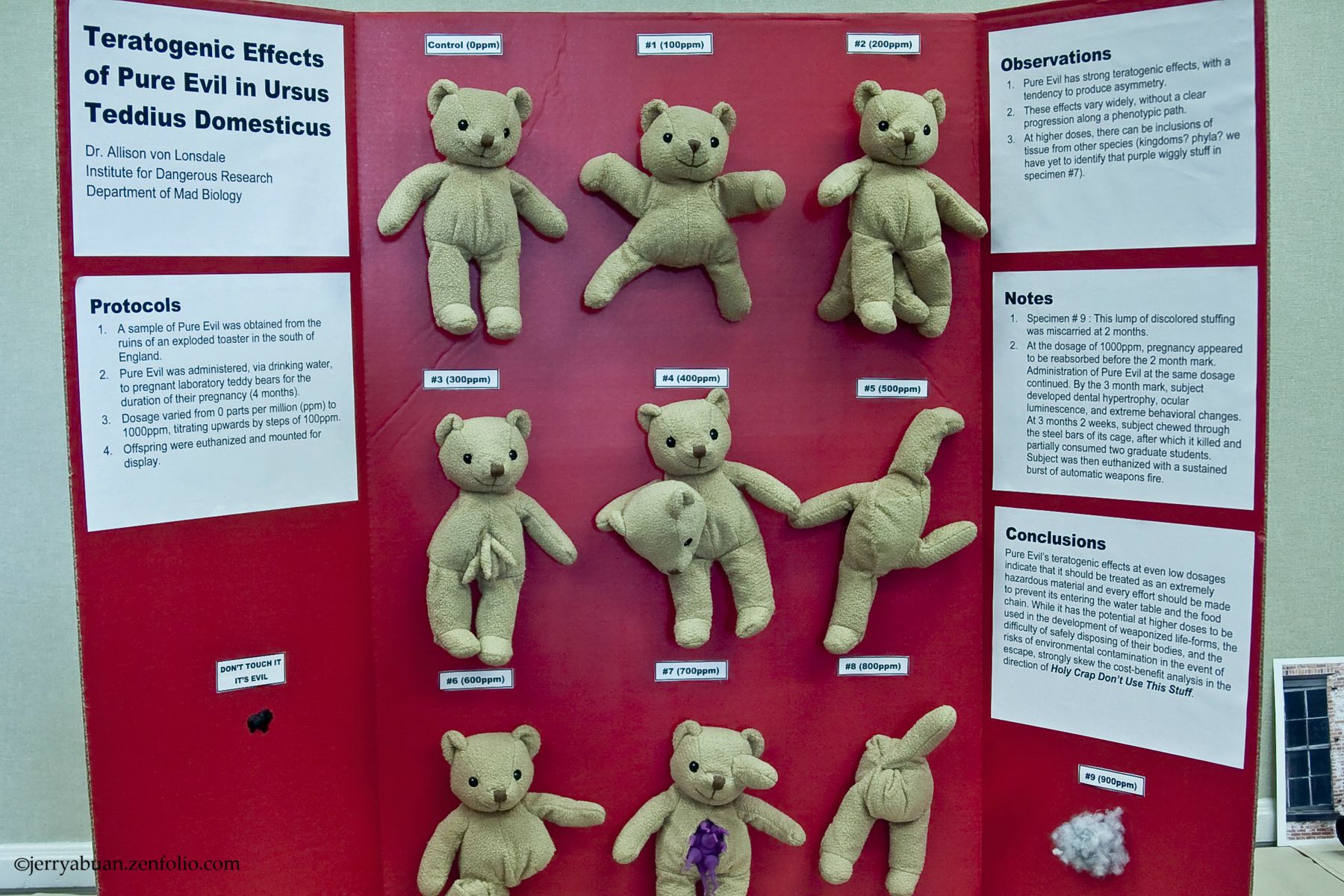
Yesterday was Bunsen Burner Day.  But you all know what today is.  It's the day where nothing is what it seems, especially on the web.  You can't do normal web searches anymore, popular sporting events are much different today, the U.S. political system has gotten very strange, public interest groups have unusual newsletters, lawsuits have gotten out of hand, as have science fair experiments, and apparently some people have lost their sense of humor.  
Some people have even made lists of how this day is different.   For some people, it might even be the end of the world, but don't worry, they're just kidding.

Monday, March 26, 2012

Breast Cancer Gene Case to be Reconsidered

Last week I wrote about Mayo v. Prometheus, a Supreme Court case involving the patentability of medical diagnostic processes.  In that post I predicted that the Supreme Court would tell the lower courts to reconsider another pending case involving the patenting of genes used to detect breast cancer, Association for Molecular Pathology v. Myriad Genetics, to apply the legal principles in the Mayo opinion.   That has in fact happened, according to the second page of today's Supreme Court order list.

Saturday, March 24, 2012

Hitler Reacts to Mayo v. Prometheus

The Hitler "Downfall" meme, as applied to last week's Supreme Court decision in Mayo v. Prometheus.  Courtesy of Patently-O (and apparently Robert Sachs of Fenwick & West).

Thursday, March 22, 2012

Wednesday, March 21, 2012

Tuesday, March 20, 2012

Medical Diagnostic Processes Not Patentable

In recent years medical companies have been getting patents on medical diagnostic techniques and processes.  In their simplest form, such a patent claims testing a patient to see if a certain disorder is present; and then reporting the result to the patient, or perhaps applying some treatment.  These patents have been controversial, since they potentially interfere with a doctor's ability to give advice to the patient, and with medical research generally.

Today the U.S. Supreme Court decided Mayo Collaborative Services v. Prometheus Laboratories, Inc.  The Court unanimously held that Prometheus was not entitled to a patent for treating a gastrointestinal disorder.  The patent covered administering a drug to a patent, testing the patent for the level of a metabolite, and increasing or decreasing the drug dose depending on the test result.  The patent apparently did not cover the drug itself, and did not cover any particular methods of administering the drug or doing the testing.

Justice Breyer's opinion held that the patent covered little more than a law of nature, which is not patentable under 35 U.S.C. §101.  The Court adopted a test of unpatentability for processes that merely "involve well-understood, routine, conventional activity":

In particular, the steps in the claimed processes (apart from the natural laws themselves) involve well-understood, routine, conventional activity previously engaged in by researchers in the field.  At the same time, upholding the patents would risk disproportionately tying up the use of the underlying natural laws, inhibiting their use in the making of further discoveries.

The opinion contained several other interesting statements:

If a law of nature is not patentable, then neither is a process reciting a law of nature, unless that process has additional features that provide practical assurance that the process is more than a drafting effort designed to monopolize the law of nature itself.  A patent, for example, could not simply recite a law of nature and then add the instruction “apply the law.”  Einstein, we assume, could not have patented his famous law [E=mc^2] by claiming a process consisting of simply telling linear accelerator operators to refer to the law to determine how much energy an amount of mass has produced (or vice versa).  Nor could Archimedes have secured a patent for his famous principle of flotation by claiming a process consisting of simply telling boat builders to refer to that principle in order to determine whether an object will float.
. . . even though rewarding with patents those who discover new laws of nature and the like might well encourage their discovery, those laws and principles, considered generally, are “the basic tools of scientific and technological work.”  Benson, supra, at 67.  And so there is a danger that the grant of patents that tie up their use will inhibit future innovation premised upon them, a danger that becomes acute when a patented process amounts to no more than an instruction to “apply the natural law,” or otherwise forecloses more future invention than the underlying discovery could reasonably justify.
Patent protection is, after all, a two-edged sword.  On the one hand, the promise of exclusive rights provides monetary incentives that lead to creation, invention, and discovery.  On the other hand, that very exclusivity can impede the flow of information that might permit, indeed spur, invention, by, for example, raising the price of using the patented ideas once created, requiring potential users to conduct costly and time-consuming searches of existing patents and pending patent applications, and requiring the negotiation of complex licensing arrangements.  At the same time, patent law’s general rules must govern inventive activity in many different fields of human endeavor, with the result that the practical effects of rules that reflect a general effort to balance these considerations may differ from one field to another.

This case will have broad implications for other cases.  For example, another highly publicized case involving patents on using genes to detect breast cancer is pending before the Supreme Court; next Monday the Court will likely send that case back to the lower courts for reconsideration in view of Mayo v. Prometheus.  Other cases dealing with §101 involve adding conventional things such as a computer to abstract concepts such as advertising, and those patents will be highly suspect in the future as well.

Here are discussions of the case by SCOTUSblog and the Patently-O blog.  UPDATE:  More posts by EFF, Techdirt and Michael Risch.


Monday, March 19, 2012

Good News: Pi Is Not Copyrightable

Two different composers wrote musical works based on the sequence of Pi (the irrational number that begins 3.14159 . . . ).  The second composer assigned different notes to the numbers so the songs sounded differently.  As reported by Eric Goldman and Techdirt, a district Judge has dismissed the first composer's copyright suit against the second.  Fortunately, basic facts like the value of Pi are not copyrightable.

Friday, March 16, 2012

Copyright Math Explained!

The content industry claims that the U.S. economy loses $58 billion annually due to content theft.  In a TED talk, Rob Reid analyzes this "copyright math."  Not surprisingly, the content industry's numbers don't quite add up.  Best line: "Some people think that string theory is tough."

Monday, March 12, 2012

Headlines of the Day

There were a number of candidates for today's headline of the day.

Failed Ph.D. Candidate

I never did get a Ph.D., only an MSEE and a J.D.  However, I don't feel too bad, because THIS guy didn't get a Ph.D. either.

Saturday, March 10, 2012

Thursday, March 1, 2012

I Wish I Had Tried One of These on my Physics 141A Final

Best exam answers.  My favorite was "If I made any mistakes in this test, perhaps this picture of a giraffe will convince you otherwise."

Friday, February 24, 2012

Ahhh, Those Start-Up Companies

Start-up companies sure can have fun with their company pictures.  (Don't miss the ukulele players, the juggler/unicyclist, the warning about leaving the toilet seat up, and the guy whose favorite color is FF69B4).

Monday, February 20, 2012

Sunday, February 12, 2012

Capitol v. Thomas: My Latest Amicus Brief

On Friday February 10, EFF filed an amicus brief I helped write.  The case is Capitol Records, Inc. et al. v. Jammie Thomas-Rasset.  Capitol had sued Ms. Thomas for unauthorized file-sharing of 24 songs.  After a jury awarded Capitol $1.5 million in damages, the trial judge reduced the award to $54,000, which is still many, many times the actual possible damages of about $360 (24 songs times $15/album on which they appear).  Capitol appealed, asking that the jury's million-dollar award be reinstated.

EFF's amicus brief discussed two issues.  First, it argued that statutory copyright damage awards must pass constitutional due process review, which the jury's $1.5 million award clearly didn't.  Second, the brief rejected Capitol's argument that "distribution" of a copyrighted work included merely "making available" the work to others, instead of an actual transfer of unauthorized copies.

Wednesday, February 8, 2012

Nifty Collection of Patent Tools

MaxVal Group has a nifty selection of Free Patent Tools.  These include a USPTO Widget, which searches multiple databases; a patent term estimator; a claim chart generator; and others. 

Sunday, February 5, 2012

Best Super Bowl 2012 Commercials

Here are the 2012 Super Bowl commercials I liked the most.  In decreasing order.  
 
1.  Chevrolet's "Mayan Apocalypse."

2.  Toyota's "Camry Reinvented."  If Toyota invented the rest of these things, it would be really cool.

3.  Best Buy's mobile phone ad.  Featuring some real inventors and their inventions.

4.  Chrysler and Clint Eastwood -- Halftime in America.  Inspiring.
 
5.  The FIAT 500 Abarth shows us what dreams are made of.

6.  Chevrolet's graduation present.  Or so he thinks.

7.  Doritos and the missing cat.  Because bribery works sometime.

8.  Pepsi Max plays another prank on that poor Coca-Cola driver.

9.  If you like vampires, you'll love the new Audi.

10.  Chevrolet's homage to stunt ads, not to be tried at home, or elsewhere.

11.  Seinfeld really wants this Acura.

12.  Skechers and the moonwalking dog.
 
Note that some of these links might disappear if the advertisers remove them.  (Not necessarily a DMCA issue, just an advertising issue.)

Wednesday, February 1, 2012

Facebook Files for its Public Offering

"A million dollars isn't cool, you know what's cool?  A billion dollars."
-- Attributed to Sean Parker in the 2010 movie, The Social Network.

Today Facebook filed for its public offering.  Its registration statement (SEC Form S-1) is here.
I'll let the corporate folks figure out the financial aspects of this thing.  But in 2011, Facebook had net income of $1 billion on revenue of $3.7 billion.  I did look at the document to see if there are any interesting disclosures about intellectual property or similar issues.  There were surprisingly few, and nothing of any real interest.  Mostly it's the same boilerplate you see in any technology SEC filing.

At the beginning, "Summary Risk Factors" merely says:
Our business is subject to complex and evolving U.S. and foreign laws and regulations regarding privacy, data protection, and other matters. Many of these laws and regulations are subject to change and uncertain interpretation, and could harm our business;
Next, there is a generic reference to "legislative proposals" that doesn't mention things like SOPA/PIPA explicitly:
Our business is subject to complex and evolving U.S. and foreign laws and regulations regarding privacy, data protection, and other matters. Many of these laws and regulations are subject to change and uncertain interpretation, and could result in claims, changes to our business practices, increased cost of operations, or declines in user growth or engagement, or otherwise harm our business.

We are subject to a variety of laws and regulations in the United States and abroad that involve matters central to our business, including user privacy, rights of publicity, data protection, content, intellectual property, distribution, electronic contracts and other communications, competition, protection of minors, consumer protection, taxation, and online payment services. Foreign data protection, privacy, and other laws and regulations are often more restrictive than those in the United States. These U.S. federal and state and foreign laws and regulations are constantly evolving and can be subject to significant change. In addition, the application and interpretation of these laws and regulations are often uncertain, particularly in the new and rapidly evolving industry in which we operate. For example, the interpretation of some laws and regulations that govern the use of names and likenesses in connection with advertising and marketing activities is unsettled and developments in this area could affect the manner in which we design our products, as well as our terms of use. A number of proposals are pending before federal, state, and foreign legislative and regulatory bodies that could significantly affect our business. For example, a revision to the 1995 European Union Data Protection Directive is currently being considered by European legislative bodies that may include more stringent operational requirements for data processors and significant penalties for non-compliance. Similarly, there have been a number of recent legislative proposals in the United States, at both the federal and state level, that would impose new obligations in areas such as privacy and liability for copyright infringement by third parties. These existing and proposed laws and regulations can be costly to comply with and can delay or impede the development of new products, result in negative publicity, increase our operating costs, require significant management time and attention, and subject us to claims or other remedies, including fines or demands that we modify or cease existing business practices.
Then there is a generic discussion of IP litigation that also doesn't mention anything in particular.
We are currently, and expect to be in the future, party to patent lawsuits and other intellectual property rights claims that are expensive and time consuming, and, if resolved adversely, could have a significant impact on our business, financial condition, or results of operations.

Companies in the Internet, technology, and media industries own large numbers of patents, copyrights, trademarks, and trade secrets, and frequently enter into litigation based on allegations of infringement, misappropriation, or other violations of intellectual property or other rights. In addition, various “non-practicing entities” that own patents and other intellectual property rights often attempt to aggressively assert their rights in order to extract value from technology companies. We presently are involved in many such lawsuits, and as we face increasing competition and gain an increasingly high profile, including in connection with our initial public offering, we expect the number of patent and other intellectual property claims against us to grow. In addition, from time to time we may introduce new products, including in areas where we currently do not compete, which could increase our exposure to patent and other intellectual property claims from competitors and non-practicing entities.

Although the results of litigation and claims cannot be predicted with certainty, we do not believe that the final outcome of intellectual property claims that we currently face will have a material adverse effect on our business, financial condition, or results of operations. However, defending patent and other intellectual property claims is costly and can impose a significant burden on management and employees, we may receive unfavorable preliminary or interim rulings in the course of litigation, and there can be no assurances that favorable final outcomes will be obtained in all cases. We may decide to settle such lawsuits and disputes on terms that are unfavorable to us. Similarly, if any litigation to which we are a party is resolved adversely, we may be subject to an unfavorable judgment that may not be reversed upon appeal. The terms of such a settlement or judgment may require us to cease some or all of our operations or pay substantial amounts to the other party. In addition, we may have to seek a license to continue practices found to be in violation of a third party’s rights, which may not be available on reasonable terms, or at all, and may significantly increase our operating costs and expenses. As a result, we may also be required to develop alternative non-infringing technology or practices or discontinue the practices. The development of alternative non-infringing technology or practices could require significant effort and expense or may not be feasible. Our business, financial condition, or results of operations could be adversely affected as a result.
The "Legal Proceedings" disclosure only mentions one specific lawsuit, the Paul Ceglia suit.
Legal Proceedings

We are currently parties to multiple lawsuits related to our products, including patent infringement lawsuits brought by both other companies and non-practicing entities as well as class action lawsuits brought by users and advertisers, and we may in the future be subject to additional lawsuits and disputes.

We are also involved in other claims, lawsuits, government investigations, settlements, and proceedings arising from the ordinary course of our business.

Paul D. Ceglia filed suit against us and Mark Zuckerberg on or about June 30, 2010, in the Supreme Court of the State of New York for the County of Allegheny claiming substantial ownership of our company based on a purported contract between Mr. Ceglia and Mr. Zuckerberg allegedly entered into in April 2003. We removed the case to the U.S. District Court for the Western District of New York, where the case is now pending. In his first amended complaint, filed on April 11, 2011, Mr. Ceglia revised his claims to include an alleged partnership with Mr. Zuckerberg, he revised his claims for relief to seek a substantial share of Mr. Zuckerberg’s ownership in us, and he included quotations from supposed emails that he claims to have exchanged with Mr. Zuckerberg in 2003 and 2004. On June 2, 2011, we filed a motion for expedited discovery based on evidence we submitted to the court showing that the alleged contract and emails upon which Mr. Ceglia bases his complaint are fraudulent. On July 1, 2011, the court granted our motion and ordered Mr. Ceglia to produce, among other things, all hard copy and electronic versions of the purported contract and emails. On January 10, 2012, the court granted our request for sanctions against Mr. Ceglia for his delay in compliance with that order. We continue to believe that Mr. Ceglia is attempting to perpetrate a fraud on the court and we intend to continue to defend the case vigorously.

The Enforcement Division of the Securities and Exchange Commission (SEC) has been conducting an inquiry into secondary transactions involving the sale of private company securities as well as the number of our stockholders of record. In connection with this inquiry, we have received both formal and informal requests for information from the staff of the SEC and we have been fully cooperating with the staff. We have provided all information requested and there are no requests for documents or information that remain outstanding. We believe that we have been in compliance with the provisions of the federal securities laws relating to these matters.

Although the results of claims, lawsuits, government investigations, and proceedings in which we are involved cannot be predicted with certainty, we do not believe that the final outcome of the matters discussed above will have a material adverse effect on our business, financial condition, or results of operations. However, defending these claims is costly and can impose a significant burden on management and employees, we may receive unfavorable preliminary or interim rulings in the course of litigation, and there can be no assurances that favorable final outcomes will be obtained.
Note 7 to the financial statements concludes with this: "We are party to various legal proceedings and claims which arise in the ordinary course of business. In the opinion of management, as of December 31, 2011, there was not at least a reasonable possibility that we had incurred a material loss, or a material loss in excess of a recorded accrual, with respect to loss contingencies."  Your call as to what the second sentence means.